Last updated: 21 November 2026
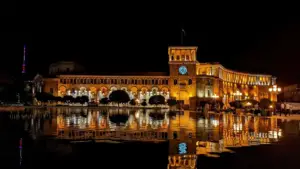
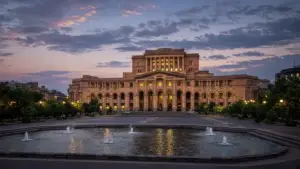
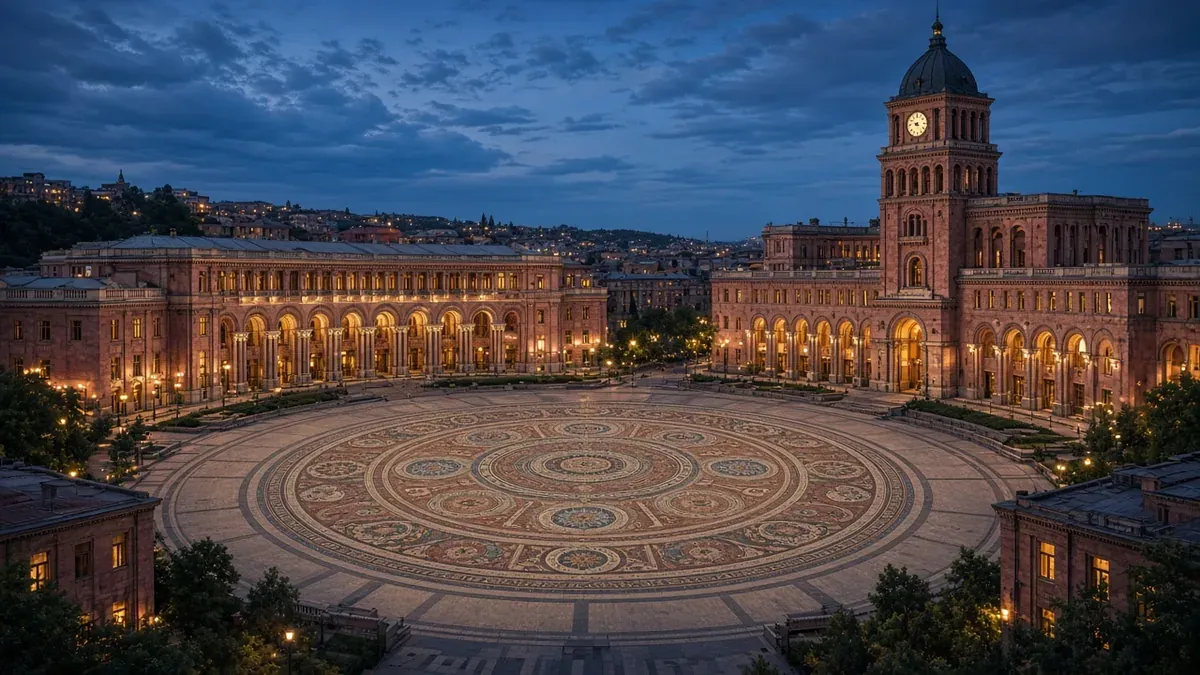
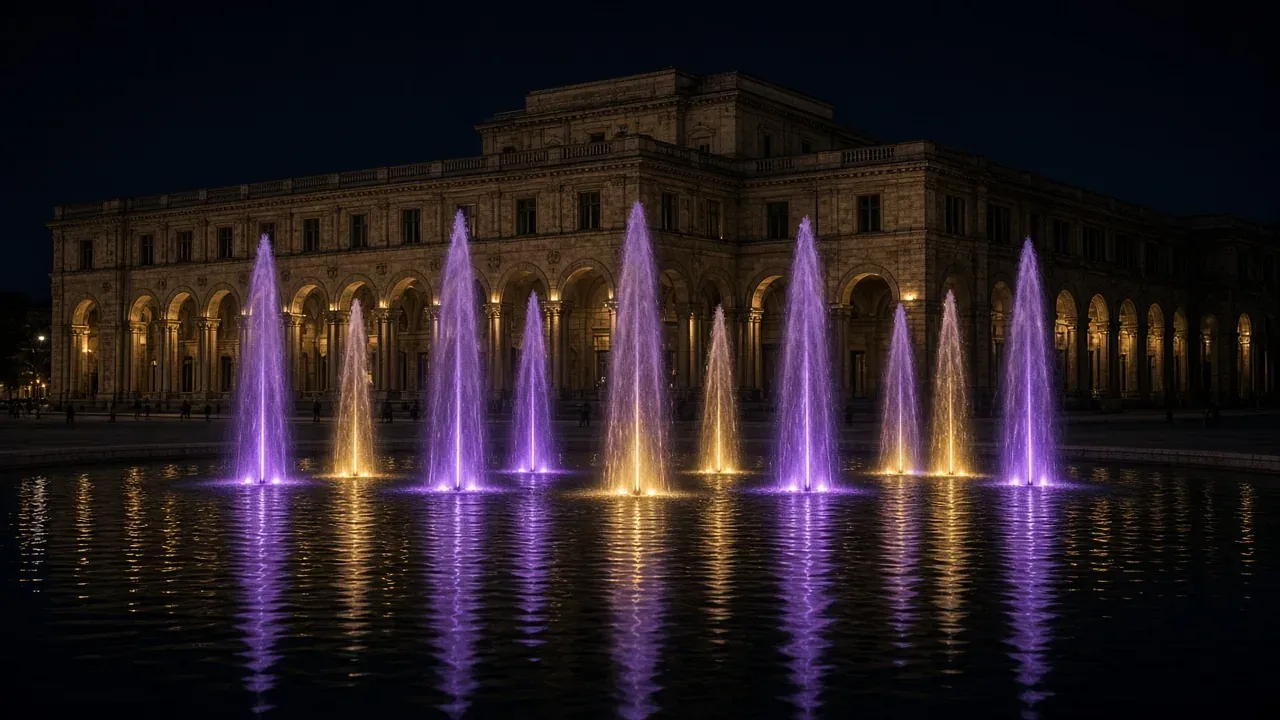
Republic Square is the heart of Yerevan. Five grand buildings of pink and cream stone stand around an oval and a long pool. Every visitor ends up here sooner or later. By day people come for the architecture, and by night for the fountains.
Five streets meet here: Abovyan, Nalbandyan, Amiryan, Vazgen Sargsyan and Tigran Mets Avenue. A few steps north, Northern Avenue leads on to the Opera. This guide covers both, and how the square came to look the way it does.
Key Facts
- Architect: Alexander Tamanian, 1924 general plan of Yerevan
- Built: 1926 to 1980, in stages
- Area: 3.5 hectares
- Names: Lenin Square from 1940 to 1990
- Metro: Republic Square station, opened 1981
- Entry: free, open day and night
In this guide · 6 sections
How Republic Square Was Built
The square comes from Alexander Tamanian’s 1924 general plan of Yerevan. Where it stands there used to be an ordinary neighbourhood of the old town. In 1935 the city cleared it. Yerevan’s official guide lists the houses, a bathhouse, a cinema and the Petit-Champs restaurant among the buildings pulled down.
The first building to rise was the Government House. Its first part, a two-storey ministry on Nalbandyan Street, went up in 1926–1929. According to the Government of Armenia, this building then set the height, scale and style of the whole square.
Tamanian died in 1936, before the work was done. His son Gevorg finished the Government House in 1952. The last piece was the National Gallery’s tall octagonal drum, 42 metres high. It was finished in 1980, almost six decades after the plan.
The Buildings Around the Square
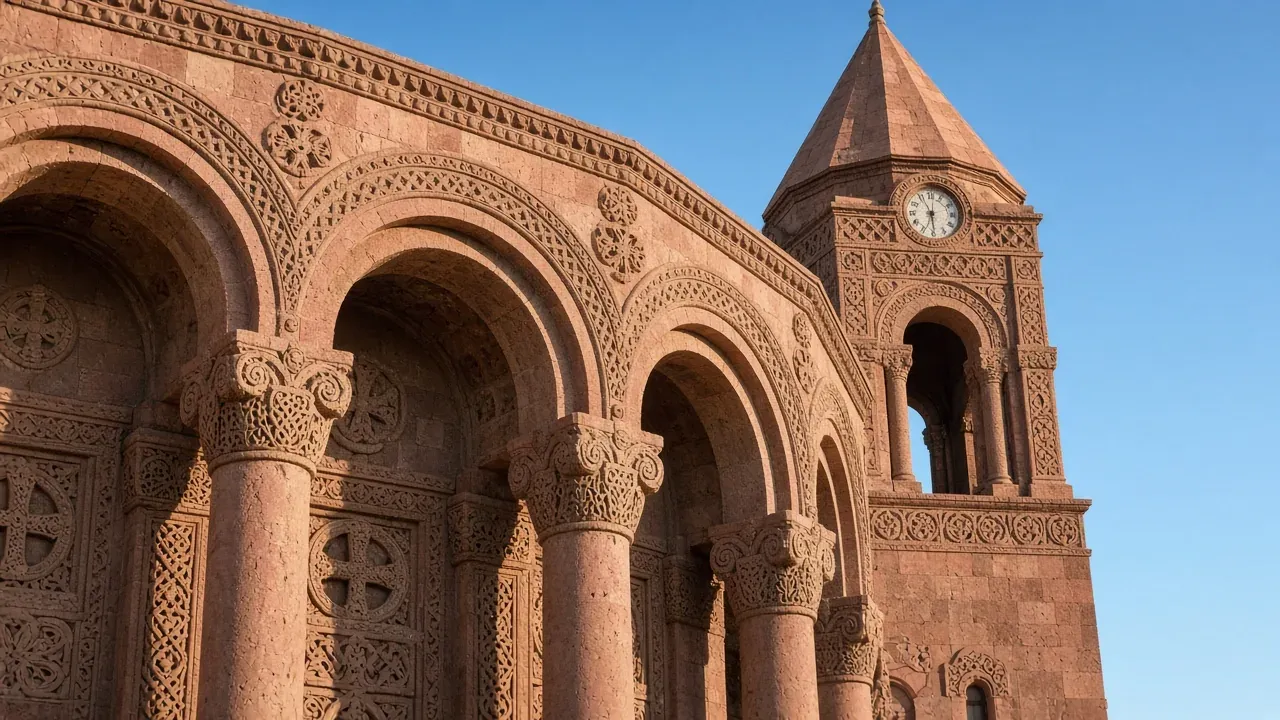
Each building has its own story, but they share their stone. The walls are polished pink tuff and light cream felsite, with grey basalt at the base. Carvings on capitals and cornices borrow from early Armenian churches such as Zvartnots, Dvin and Talin.
- Government House – the oldest, with a 30-metre clock tower. It won the USSR State Prize in 1941.
- Second Government House – built 1944–1955, once home to the “Ararat” restaurant.
- Armenia Hotel – opened in 1958 and known today as the Armenia Marriott.
- Trade Unions and Communications building – 1956–1978, hiding a 1935 constructivist Communications House behind its facade.
- Museums building – home of the History Museum of Armenia and, in its inner drum, the National Gallery.
The Museums building has the oddest history. It began as the old boys’ gymnasium, which became a House of Culture in the 1940s. The architects kept its interior and its facade on Abovyan Street. In 1954 they added a third floor, a vaulted ceiling and an open colonnade facing the square.
The Second Government House was the work of Samvel Safaryan. Its “Ararat” restaurant had a mural by the painter Hovhannes Zardaryan. Even the metro station below the square, opened in 1981, won a State Prize, in 1983.
The whole complex won the State Prize of the Armenian SSR in 1971. Yerevan’s official guide calls it one of the best works of Soviet architecture.
From Lenin Square to Republic Square
From 1940 to 1990 this was Lenin Square. A 7-metre copper statue of Lenin by Sergey Merkurov was unveiled at its southern end on 24 November 1940. With its granite pedestal it stood 18.2 metres tall. Many thought it one of the finest Lenin monuments in the Soviet Union.
On 28 March 1991 the Yerevan City Council voted to take it down. Workers lifted the statue off its pedestal on 13 April 1991, months before the Soviet Union ended. The empty pedestal stayed in the square until July 1996.
The square was renovated in 2003. A stone mosaic that looks like a carpet now fills the centre of the oval. During that work, archaeologists found vaulted cellars near the pool. They belonged to houses of the 18th to 20th centuries, the last trace of the old quarter.
The Fountains
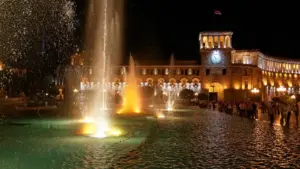
The fountains in the long pool in front of the Museums building date from 1953. In 1970 the radio technician Abraham Abrahamyan turned them into colour-and-sound fountains. The French firm Aquatic Show International rebuilt them in 2007. They are the city’s famous singing fountains.
Beside them is the smaller “Seven Springs” fountain of 1965, renovated by the sculptor Arman Nur in 2010. Together the two pools and the five stone buildings make the square’s evening picture.
Northern Avenue
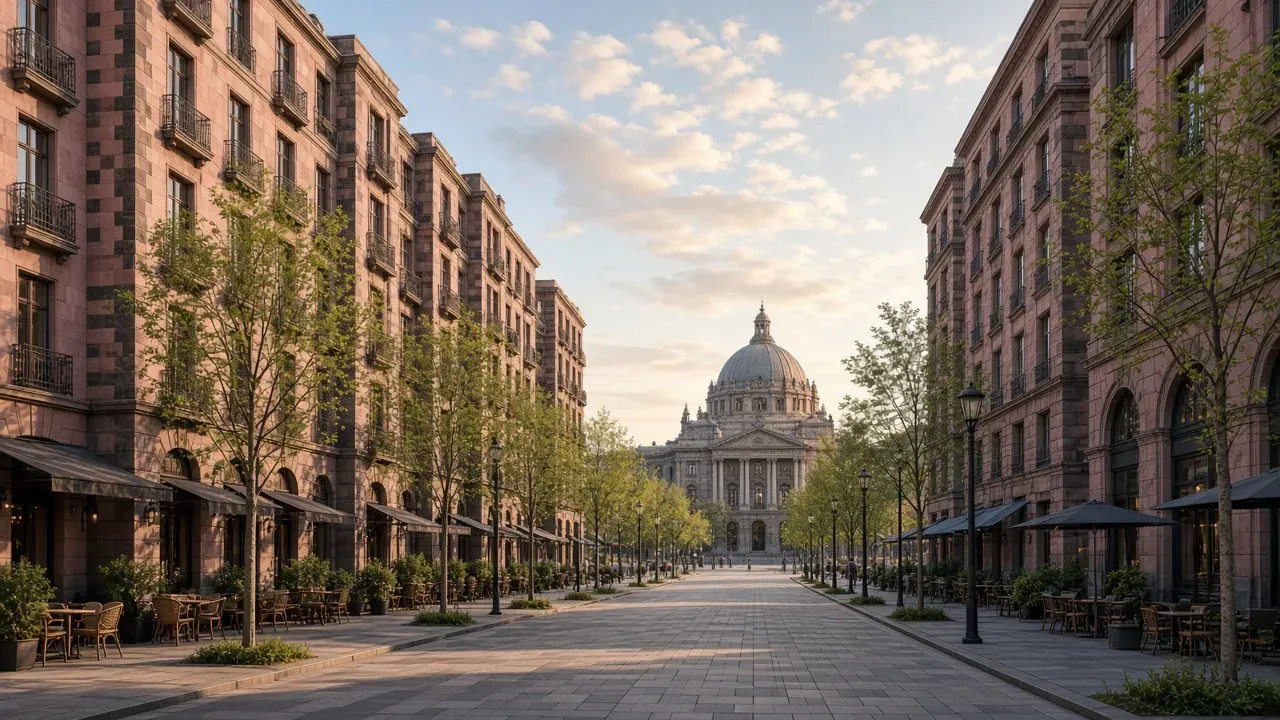
Tamanian always meant Republic Square to be linked to the Opera by a grand street, the “Northern Avenue”. It stayed on paper for eight decades. Work finally began in the early 2000s on land cleared of old houses. Narek Sargsyan was chief architect, and ten teams shared the plots.
The avenue opened on 16 November 2007. A study in the Bulletin of Yerevan State University gives its size as 450 by 27 metres. Along it are four small squares and 11 buildings of about nine floors each. It is open only to people on foot, and it is lined with shops, cafés and hotels.
At the opening ceremony, PAN.am reported, President Robert Kocharyan called the avenue Armenia’s second calling card after Republic Square. Construction was then a major part of the economy, he said, and tens of thousands of people worked in it.
The same study notes another side of the story. Many residents of the old quarter lost their homes to the project. According to the authors, most had still not received compensation in 2020. As a result, some locals at first found the new street cold and strange.
A Walk from the Square to the Cascade
Start at Republic Square metro station, opened in 1981. Walk around the oval, then go one short block along Abovyan Street to the start of Northern Avenue. At the far end you reach Freedom Square and the Opera House. From there it is a short climb to the Yerevan Cascade.
The best time is the evening, when the buildings glow and the fountains run. For dinner afterwards, see our guide to Yerevan restaurants.
So, visit Republic Square twice, once in daylight and once at night. Then let it be the start of your walk through Yerevan.
Questions Visitors Ask
Who designed Republic Square?
Alexander Tamanian, in his 1924 general plan of Yerevan. His son Gevorg and other architects completed it.
Why was it called Lenin Square?
It carried Lenin’s name from 1940 to 1990, and his statue stood there until 13 April 1991.
How long is Northern Avenue?
About 450 metres, from Abovyan Street to Freedom Square and the Opera House.
Sources
- Visit Yerevan (Yerevan Municipality), “Republic Square”, read 21 November 2026. visityerevan.am
- Visit Yerevan, “First Government House”, read 21 November 2026. visityerevan.am
- Government of the Republic of Armenia, “History of the Government building”, read 21 November 2026. gov.am
- PAN.am, “Opening ceremony of Northern Avenue took place in Yerevan”, 16 November 2007. pan.am
- Vermishyan H., Michikyan S., “The transformation of urban public space of post-Soviet Yerevan: the case of Northern Avenue”, Bulletin of Yerevan University, 2020. journals.ysu.am
- Wikidata, Republic Square (Q2584192): coordinates. wikidata.org
More of Yerevan is on iArmenia.