Last updated: 13 November 2026· Facts checked November 2026
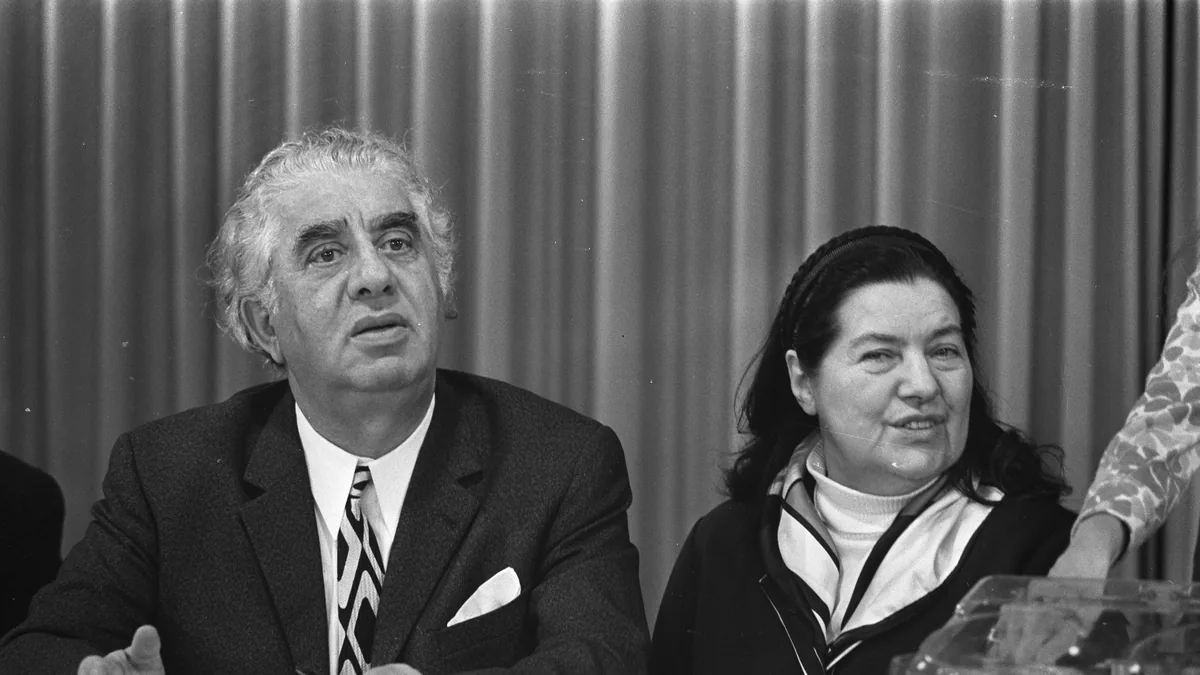
Aram Khachaturian (Արամ Խաչատրյան, 1903–1978) was an Armenian composer best known for the Sabre Dance from his ballet Gayane and for the ballet Spartacus. He also wrote the Masquerade Waltz and three admired concertos, for piano, violin and cello.
Born in Tiflis (today’s Tbilisi) and trained in Moscow, he became one of the leading composers of the Soviet Union. He is buried in Yerevan, where his house is now a museum and the main concert hall carries his name.
Key Facts
- Born: 6 June 1903, Tiflis (Tbilisi), then in the Russian Empire
- Died: 1 May 1978, Moscow
- Buried: Komitas Pantheon, Yerevan
- Best known for: Sabre Dance (from Gayane), Spartacus, the Masquerade Waltz, the Violin Concerto
- Museum: Aram Khachaturian House-Museum, 3 Zarobyan Street, Yerevan; adult ticket 1,500 AMD (about $4) as of November 2026
In this guide · 6 sections
Aram Khachaturian: Early Life
Khachaturian was born on 6 June 1903 into an Armenian family in Tiflis, the multi-ethnic capital of the Caucasus. He was the youngest of five children. His father, Yeghia, was a bookbinder who ran his own workshop.
In the early 1920s Aram followed his older brother Suren, a stage director at the Moscow Art Theatre’s studio, to Moscow. In 1922, aged 19, he enrolled at the Gnessin music school, starting on the cello.
He started music school at 19 as a cellist, and only in 1925, when the school opened a composition class, did he begin to compose.
That class was led by Mikhail Gnessin. In 1929 Khachaturian moved on to the Moscow Conservatory, where he studied composition with Nikolai Myaskovsky into the mid-1930s.
Khachaturian’s Work
| Work | Year | Why it matters |
|---|---|---|
| Piano Concerto in D-flat major | 1936 | His first work to win recognition abroad |
| Violin Concerto in D minor | 1940 | Written for and first played by David Oistrakh; won a Stalin Prize in 1941 |
| Masquerade (music for the play; suite) | 1941; suite 1944 | For Lermontov’s play; the Waltz is one of his most played pieces |
| Gayane (ballet) | 1942 | First staged in December 1942 in Perm by the evacuated Kirov company; contains the Sabre Dance |
| Symphony No. 2 | 1943 | A wartime symphony; Stalin Prize 1946 |
| Anthem of the Armenian SSR | 1944 | Soviet Armenia’s state anthem |
| Cello Concerto | 1946 | Completes his trio of concertos |
| Spartacus (ballet) | composed 1950–54; first staged 1956 | Lenin Prize 1959; Yuri Grigorovich’s 1968 Bolshoi version made it world-famous |
| Concerto-Rhapsodies for violin, cello and piano | 1960s | Late works; the set won a USSR State Prize in 1971 |
Gayane and the Sabre Dance
Gayane reuses music from his earlier ballet Happiness (1939). It was first staged in December 1942 in Perm, in the Urals, where the Kirov company from besieged Leningrad had been evacuated. Nina Anisimova choreographed it.
The Sabre Dance was a late addition. According to the composer’s own account, the theatre asked for one more dance, and he wrote it in a single sitting of about eleven hours. The short, fast piece soon became a hit far beyond the ballet.
Its fame was not entirely welcome. His publisher, Boosey & Hawkes, notes that he later saw the piece as an embarrassment, because it overshadowed the rest of the score. The slow Adagio from the same ballet is heard in Stanley Kubrick’s 2001: A Space Odyssey (1968).
Spartacus
The ballet about the slave revolt in ancient Rome was first staged by the Kirov in Leningrad on 27 December 1956, with choreography by Leonid Yakobson. The version still danced today is Yuri Grigorovich’s 1968 production at the Bolshoi in Moscow. The Adagio of Spartacus and Phrygia later reached British viewers as the theme of the BBC series The Onedin Line.
Awards and Recognition
- Stalin (State) Prizes – 1941, 1943, 1946 and 1950, for the Violin Concerto, Gayane, Symphony No. 2 and the film score The Battle of Stalingrad
- People’s Artist of the USSR – 1954
- Lenin Prize – 1959, for Spartacus
- USSR State Prize – 1971, for the three Concerto-Rhapsodies
- Hero of Socialist Labour – 1973
The 1948 Decree
On 10 February 1948 the Central Committee of the Soviet Communist Party issued a resolution on music. It grew out of the anti-“formalist” campaign led by Andrei Zhdanov. The resolution named six composers as formalists: Khachaturian, Dmitri Shostakovich, Sergei Prokofiev, Nikolai Myaskovsky, Vissarion Shebalin and Gavriil Popov.
Khachaturian, then a senior figure in the Composers’ Union, lost his post there. Concert organisers dropped most of the accused composers’ music. The pressure eased after Zhdanov’s death later in 1948.
In 1948 the Soviet Communist Party condemned Khachaturian as a “formalist”; a decade later it withdrew the charge.
After Stalin’s death in 1953, Khachaturian published an article urging fellow composers to fight for creative freedom. A decade after it was issued, in 1958, the party formally revoked the 1948 resolution.
Personal and Later Life
In 1933 Khachaturian married the composer Nina Makarova, a fellow student in Myaskovsky’s class. From the early 1950s he taught composition at the Gnessin Institute and the Moscow Conservatory.
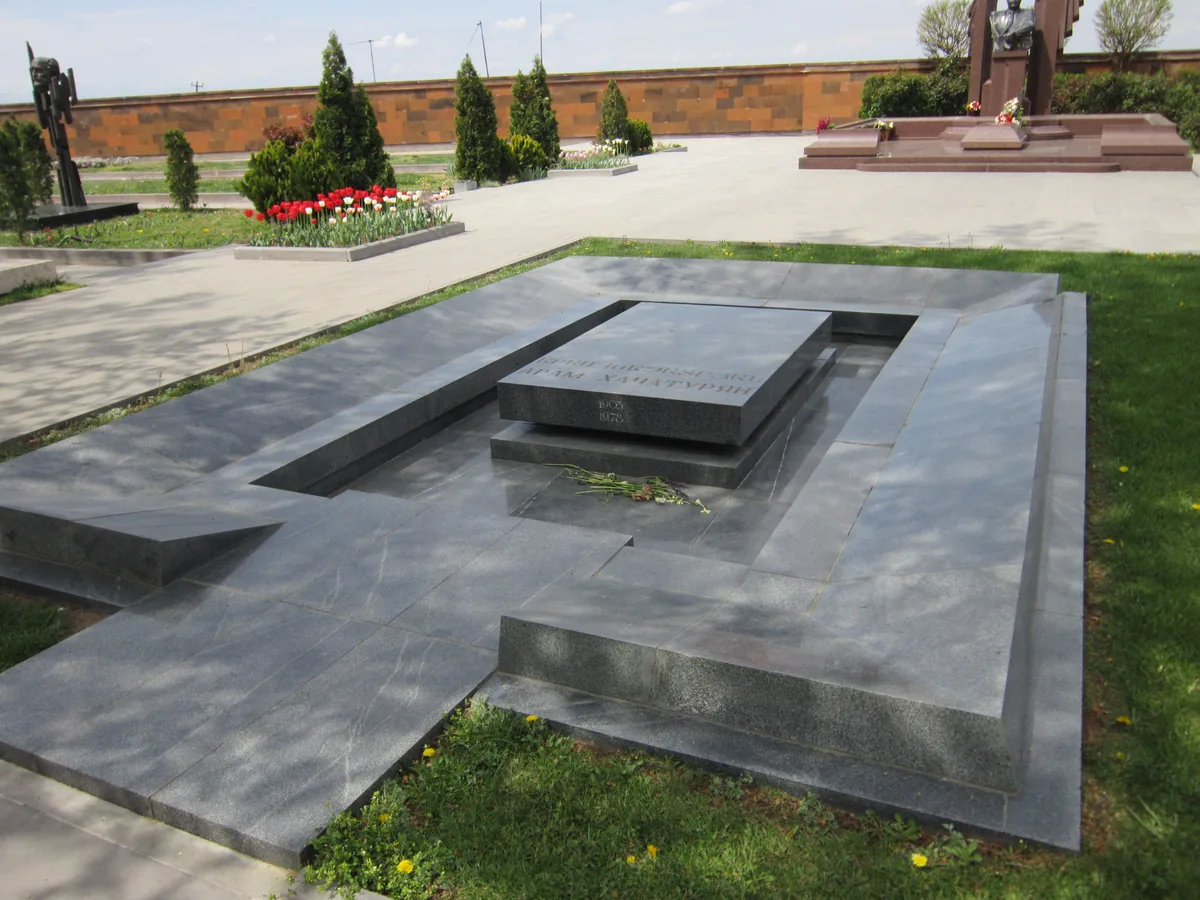
In 1950 he also began conducting his own music. He went on to perform it in more than two dozen countries, including the United States. He died in Moscow on 1 May 1978 and was buried in the Komitas Pantheon in Yerevan.
Aram Khachaturian and Armenia
Khachaturian built his style on the folk music of Armenia and the Caucasus that he heard as a child in Tiflis. That music is played on instruments such as the duduk and zurna; see our guide to Armenian musical instruments. In Armenia he is a national figure, and his name is everywhere in music life.
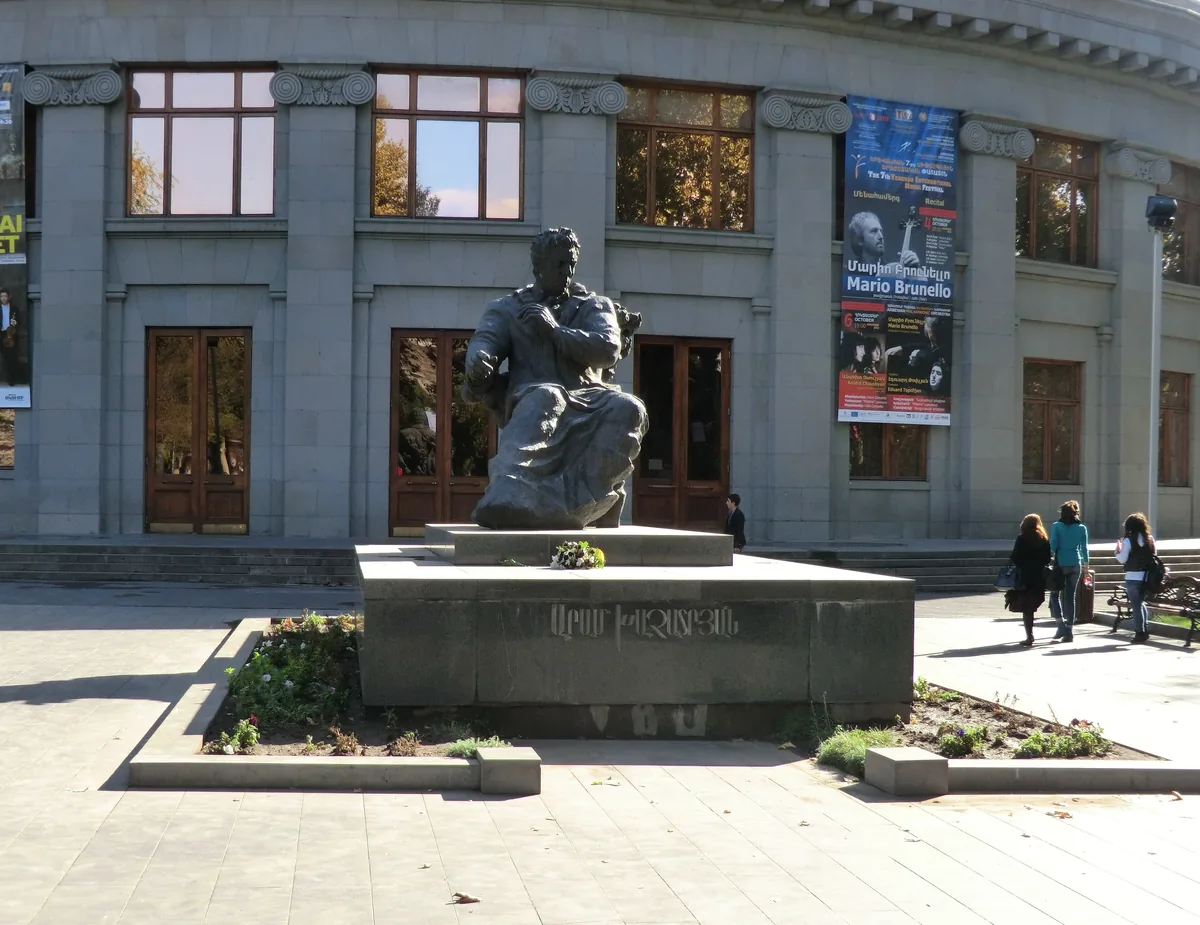
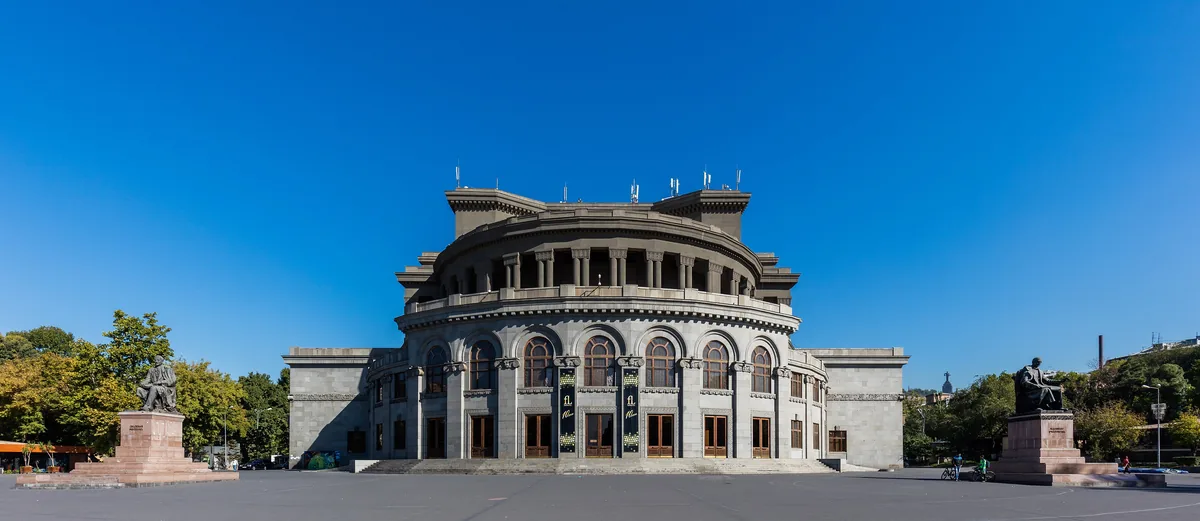
- Aram Khachaturian Concert Hall – the concert hall in Yerevan’s Opera building, home of the Armenian National Philharmonic Orchestra; his statue stands at the entrance.
- Banknote – his portrait appeared on the 50-dram note issued in 1998, with a scene from Gayane on the back; see our guide to the Armenian dram.
- Music schools – schools in Charentsavan, Kapan, Martuni and Hrazdan carry his name, according to the House-Museum.
- Komitas Pantheon – his grave lies in the same pantheon as Komitas, the founder of Armenian classical music, in Yerevan’s Shengavit district.
The Aram Khachaturian House-Museum
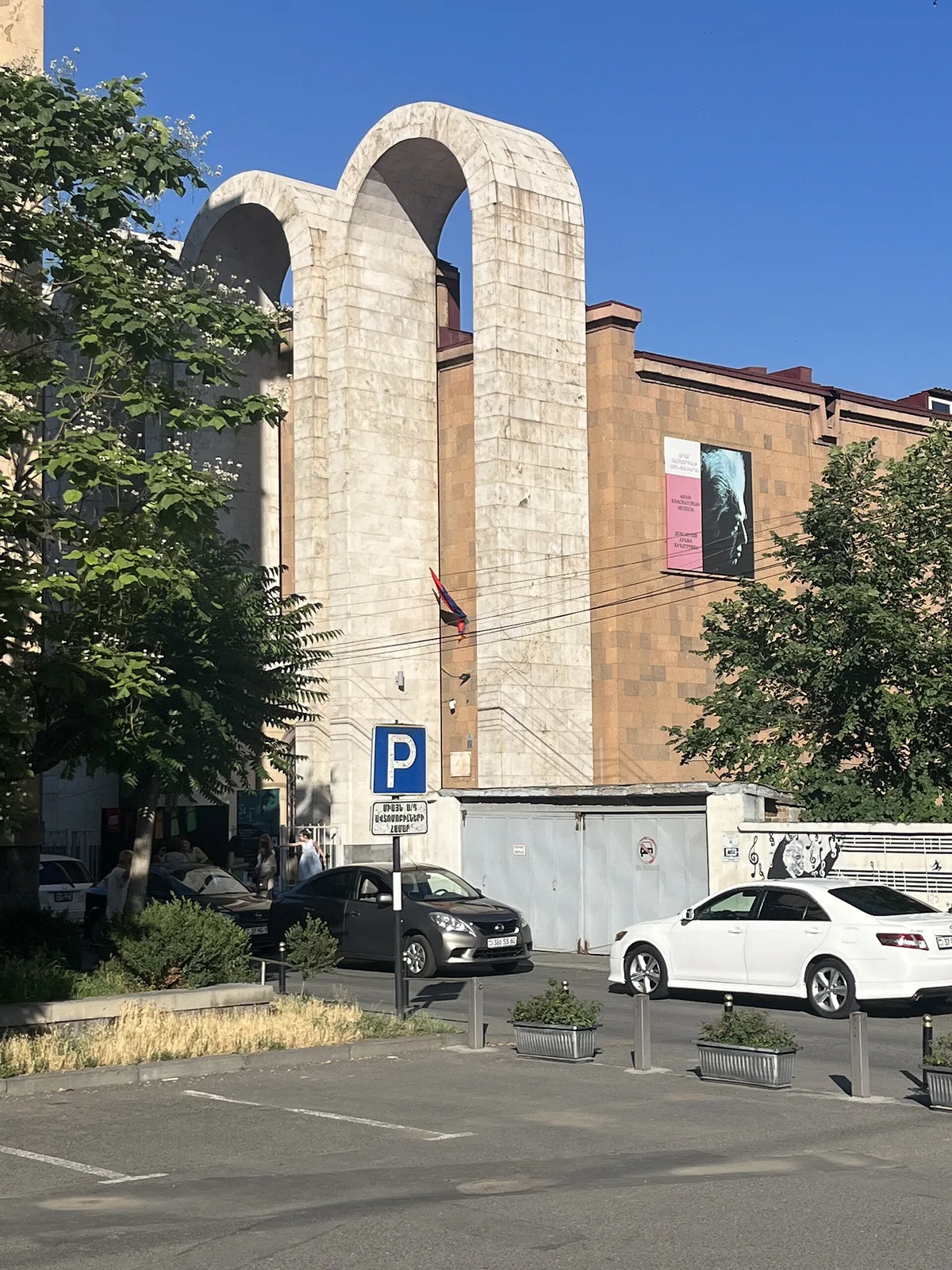
The government of Soviet Armenia gave Khachaturian a house in central Yerevan in 1945. The decision to turn it into a museum was taken on 21 July 1976, during his lifetime, and the museum was founded in 1978.
According to the museum, its collection holds more than 18,000 items: photographs, personal belongings, letters, documents and notebooks. There are ten exhibition rooms, a sound library of about 7,000 CDs and DVDs, and a concert hall for recitals.
| Practical information | Details (museum website, November 2026) |
|---|---|
| Address | 3 Zarobyan Street, Yerevan 0009 |
| Opening hours | Monday–Friday 11:00–17:00, Saturday 11:00–16:30, closed Sunday |
| Adult ticket | 1,500 AMD (about $4) |
| Students, school pupils (12+), pensioners | 750 AMD (about $2) |
| Children under 12 | Free |
| Guided tour | 3,000 AMD (about $8) in Armenian; 5,000 AMD (about $14) in English, Russian and other languages; book ahead |
| Phone | +374 10 589418 |
The museum also hosts concerts in its hall, so check its website for the programme before your visit. The Komitas Pantheon is across the city on Arshakunyats Avenue, a short taxi ride away.
The Khachaturian International Competition
Founded in 2003 for the composer’s centenary, the Khachaturian International Competition is held in Yerevan every year and opens on his birthday, 6 June. The discipline changes from year to year. The 2026 edition was for cello, and the 2027 edition is for piano, from 6 to 13 June. Applications close on 10 April 2027, and the rounds are open to the public. In 2026 the finalists played with the Armenian State Symphony Orchestra.
Where to Start Listening
- Sabre Dance (Gayane) – a few minutes of pure energy.
- Adagio of Spartacus and Phrygia (Spartacus) – his great romantic melody.
- Waltz (Masquerade) – dark, swirling and instantly memorable.
- Adagio (Gayane) – the music from 2001: A Space Odyssey.
- Violin Concerto in D minor – look for a recording by David Oistrakh, who gave the first performance.
- Piano Concerto in D-flat major – big, rhythmic and full of folk colour.
So, if you love the Sabre Dance, visit the House-Museum on Zarobyan Street when you are in Yerevan. Then hear his music live at the concert hall that carries his name.
Questions Visitors Ask
Was Aram Khachaturian Armenian or Georgian?
He was Armenian, born to an Armenian family in Tiflis (Tbilisi), which had a large Armenian community at the time.
What ballet is the Sabre Dance from?
From Gayane, first staged in December 1942.
Where is Aram Khachaturian buried?
In the Komitas Pantheon in Yerevan, alongside many of Armenia’s leading artists and writers.
Can you visit Khachaturian’s house in Yerevan?
Yes. The House-Museum at 3 Zarobyan Street is open Monday to Saturday, and an adult ticket costs 1,500 AMD, according to its website (November 2026).
Sources
- Biography, family tree, awards, conductor and ballets, khachaturian.am (read 9 November 2026)
- General information, about the museum and schools named after Khachaturian, Aram Khachaturian House-Museum (read 9 November 2026)
- House Museum of Aram Khachaturian, mus.am (read 9 November 2026)
- Gayaneh (1942 version) and Spartacus, Boosey & Hawkes (read 9 November 2026)
- The Year 1948 in Soviet Music, Marina Frolova-Walker, Gresham College, May 2022 (read 9 November 2026)
- Aram Khachaturian Concert Hall, mus.am, and Aram Khachaturian Concert Hall, Armenian National Philharmonic Orchestra (read 9 November 2026)
- Armenia 50 dram 1998, banknotes.com, and 50 dram 1998, Numisquare (read 9 November 2026)
- About the competition, Khachaturian International Competition (read 9 November 2026)
- Cello winners announced for the 2026 Khachaturian International Competition, The Strad (search excerpt, read 9 November 2026)
- 2001: A Space Odyssey – Original Soundtrack, MFiles (search excerpt, read 9 November 2026)
- Aram Khachaturian, Sabre Dance and Spartacus (ballet), Wikipedia (second source only; read 9 November 2026)
- Central Bank of Armenia exchange rate, 1 USD = 360.43 AMD on 9 November 2026
Discover more Armenian people, places and traditions on iArmenia.