Last updated: November 2026
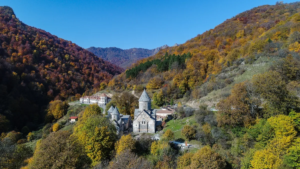
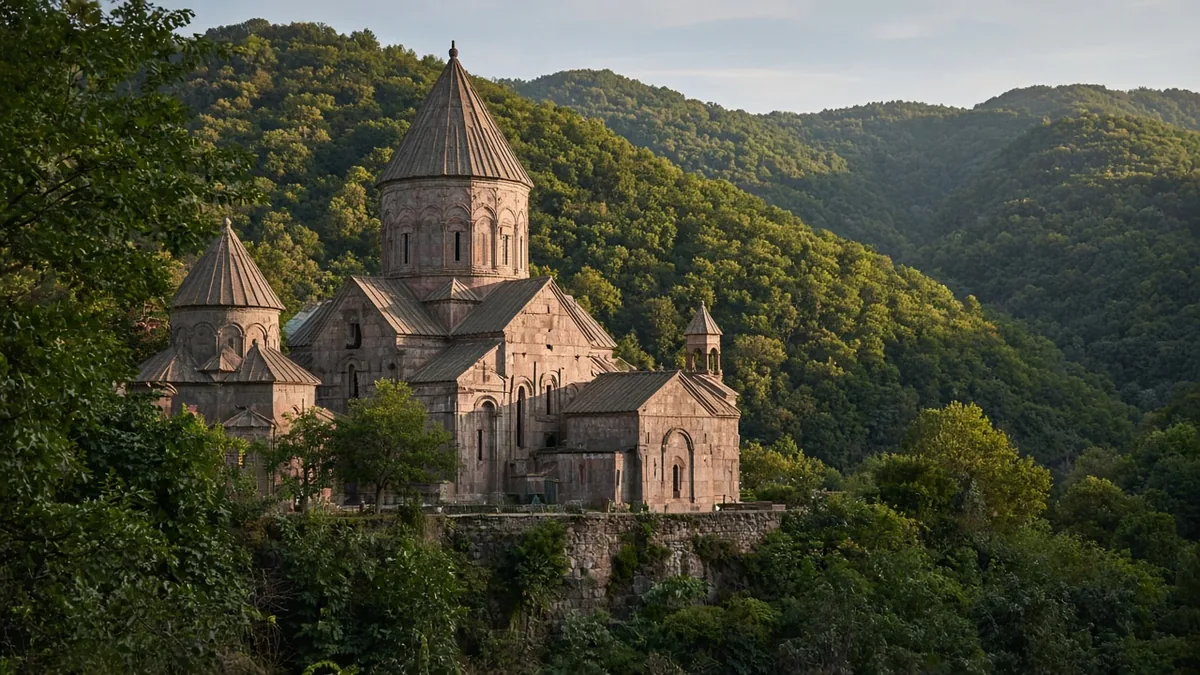
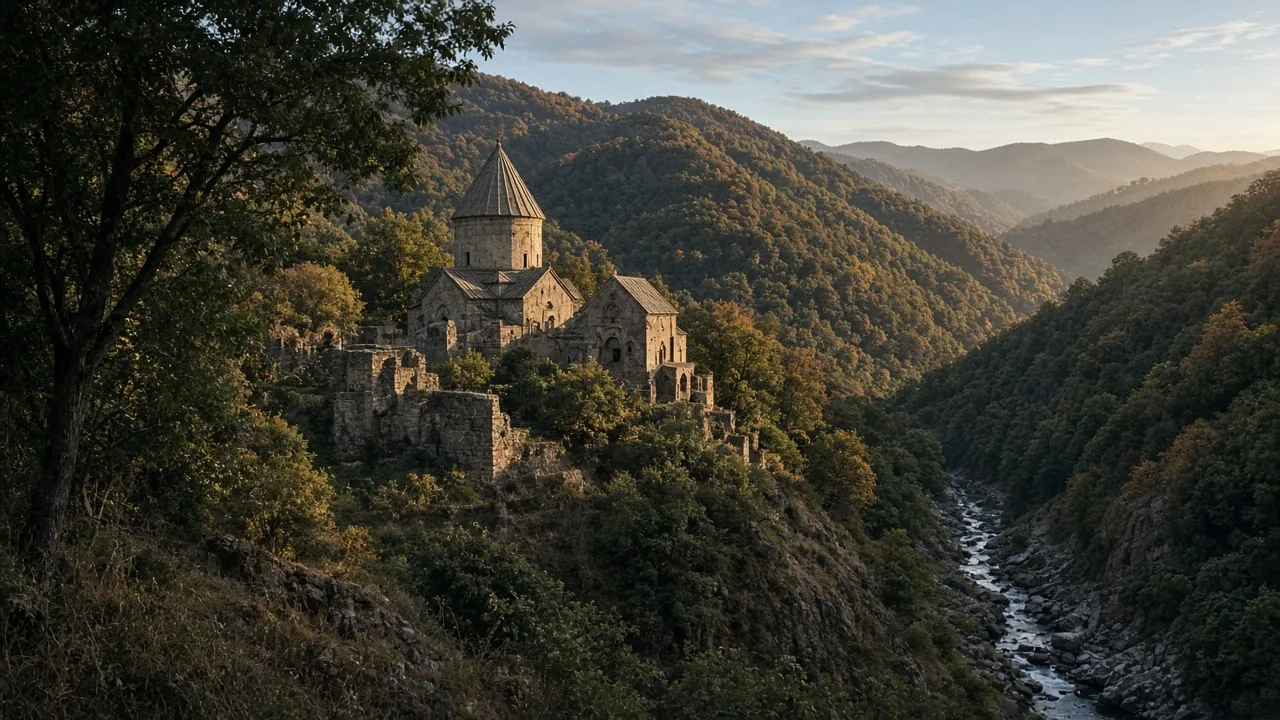
Haghartsin Monastery is a medieval Armenian monastery in the forest near Dilijan, in Tavush Province. Its Armenian name is «Հաղարծին», and the churches you see today were built between the 10th and 13th centuries.
In fact, the complex holds three churches, a gavit and a stone refectory. The monastery’s own page says the entrance is free. You reach it by road from Dilijan, inside the wooded hills of the national park.
Key Facts
- Where: near Dilijan, Tavush Province, in the forest above the Haghartsin stream
- Built: 10th–13th centuries. St Stephen’s Church is dated 1244. St Astvatsatsin was finished in 1281
- Known for: three churches, the 1248 refectory, khachkars, and a school of church music
- Entrance: free, according to the monastery’s own page (checked November 2026)
- Hours: no official timetable was published on that page [CHECK: daylight hours]
- From Dilijan: guides say about 18 km [CHECK: a road measurement on 10 November 2026 gave about 8 km and 40 minutes]
In this guide · 4 sections
History of Haghartsin Monastery
Haghartsin is thought to have been founded in the 10th century, though no document gives the exact year. The oldest large church, St Gregory’s, is usually dated to that first period. However, the complex you walk through is mostly the work of the 12th and 13th centuries.
After the Seljuk Destruction
Seljuk attacks in the 11th century nearly destroyed the monastery. From 1184 the Zakarid princes Zakare and Ivane rebuilt it. They chose Haghartsin as a family burial place, and they added a gavit, called a zhamatun, beside St Gregory’s Church.
Ivane’s inscription of 1213 says he built the family monastery of Haghartsin, with an arched gavit beside St Gregory, in memory of his brother Zakare.
The 13th-century historian Kirakos Gandzaketsi names Khachatur of Taron, a musician and abbot, as the man who enlarged the monastery.
In 1194 Khachatur was at the consecration of a church at Nor Getik, the monastery now called Goshavank. So the two forest monasteries already shared people, as well as a valley.
The Royal Graves
A ruined sepulchre stands by the south wall of St Gregory’s gavit. Two gravestones remain, and their inscriptions are only partly readable. One names a King Smbat. Another was copied in the 19th century as the grave of kings Gagik and another ruler.
Scholars do not agree who lies there. One view names kings of the Kiurikian branch of the Bagratuni family. Another names Smbat II and Gagik I.
However, the historian Stepanos Asoghik says Smbat was buried in Ani. You can read the stones, and you should treat the royal names as a dispute, not as a settled label.
The Legend of the Name
According to a tradition on the monastery’s own page, an eagle circled overhead on the day the monastery was consecrated. People took the bird as a sign of peace, and they connected that flight with the name Haghartsin. The story is told as tradition, not as a dated record.
A popular etymology splits the name into words for “played” and “eagle”. Haghartsin is also the name of the stream that runs past the churches and joins the Aghstev.
So the name may belong to the water first, and the eagle story may have grown up beside it. Either way, you will hear the eagle version from people on the path.
What to See at Haghartsin Monastery
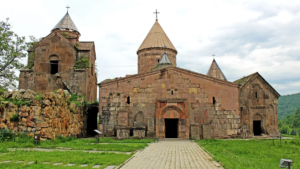
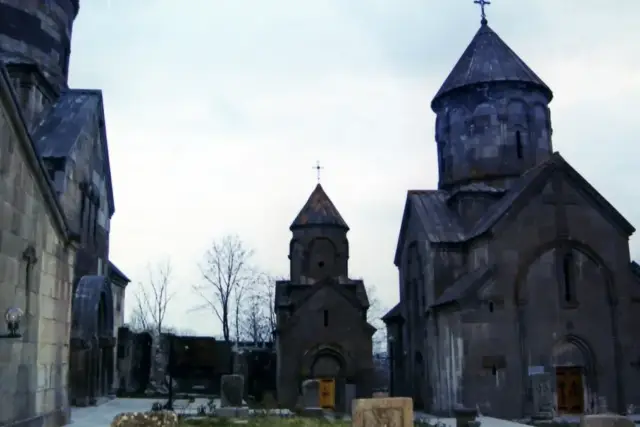
Give yourself about an hour among the buildings. The churches sit close together on a slope, with khachkars in the grass and the forest rising behind the domes. Dress so that your shoulders and knees are covered, because this is a working church, not a museum hall.
St Gregory’s Church
St Gregory’s Church, Surb Grigor, is the oldest large building, probably from the 10th century. You enter through a gavit that is wider than the church. The dome rests on an eight-sided drum. A school of church music once worked in this church, which fits the memory of Abbot Khachatur.
The 12th-century gavit is a square hall. Four supports carry the roof, and the central window above the door is shaped like a cross. Carved monks hold crosses, staffs and birds in the corner sections.
According to a local legend, one hollow half-column could be swung open so that the monks could hide valuables in time of war. Treat that as a legend.
St Astvatsatsin Church
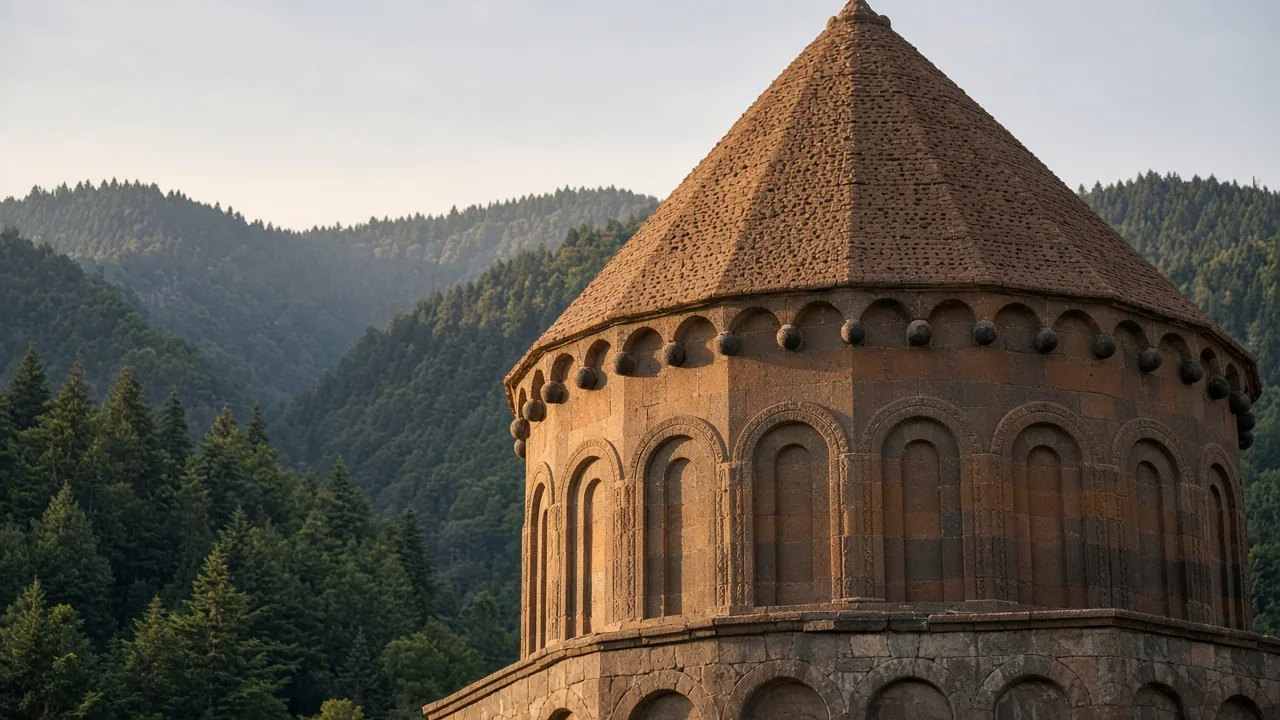
St Astvatsatsin, the Holy Mother of God, was finished in 1281 and is the largest church. Its dome has sixteen faces. Arches, spheres and a band at the base of the drum make the drum look lighter than the stone it is. The southern door is framed with rows of trefoils.
On the east wall, a relief shows two men in monks’ dress pointing at a model of a church, with a dove between them. The model’s umbrella roof records how the dome once looked.
Outside the south door stands a khachkar carved by Poghos in the 13th century. The gavit of this church is mostly ruined, so you see its footprint rather than a hall you can enter.
St Stephen’s Church and the Refectory
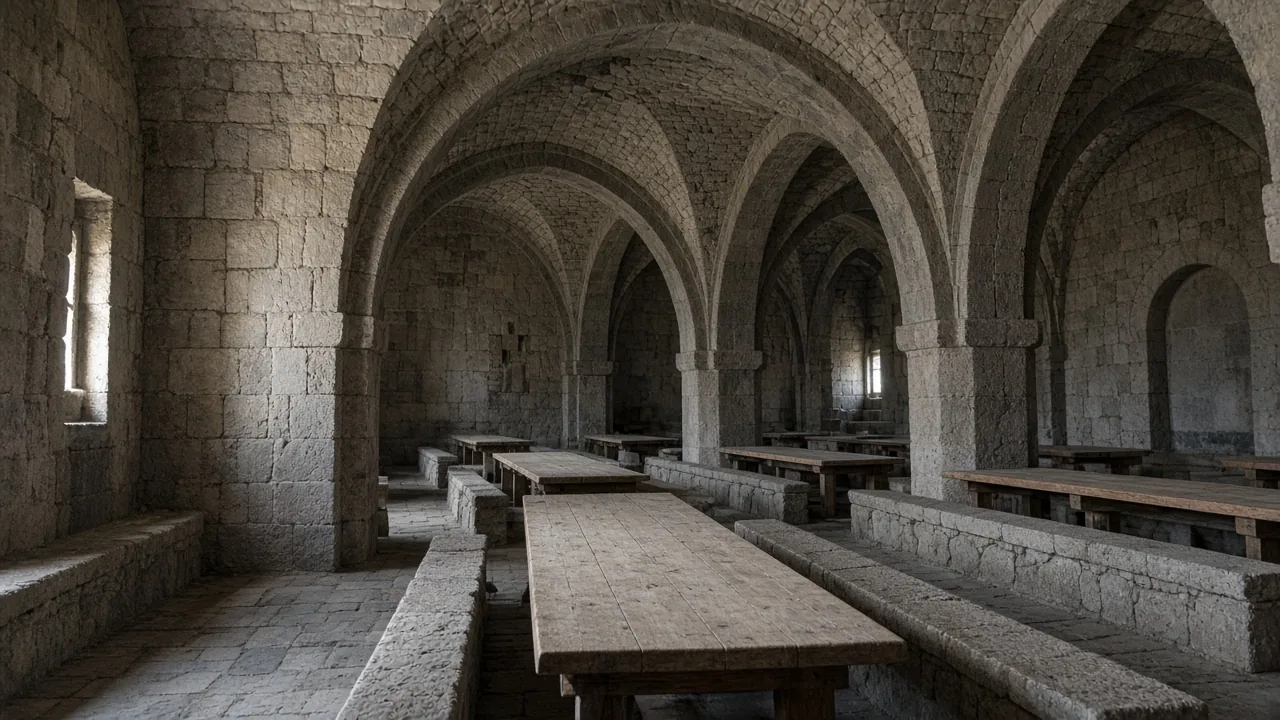
St Stephen’s Church, Surb Stepanos, is the small church dated 1244, set toward the trees. A lion carved on its wall is read as a sign of the Bagratuni family. Then you come to the refectory, built in 1248 by the architect Minas, in the same family of halls as the refectory at Haghpat.
Pillars divide the dining hall into two squares, and the roof is a set of crossing arches. Stone benches run along the walls. Wooden tables are still set out for a meal after a wedding or a baptism. The monastery’s page also mentions a bronze cauldron among the things kept on the site.
How to Get to Haghartsin Monastery
There is no marshrutka that drops you at the door. You come by car or taxi from Dilijan. Tourism itineraries put the monastery about 18 km from the town, up a paved road through the forest.
A road measurement on 10 November 2026 gave a shorter figure, about 8 km and 40 minutes, so confirm the fare with the driver before you leave town [CHECK: distance].
Also, the road and the parking area belong to the restoration of 2011. Armenia Fund carried out that work with a donation from Sultan bin Muhammad Al-Qasimi, the ruler of Sharjah.
Today you can park, look into a small shop, and walk straight to the churches. In 2017 the monastery was added to the Transcaucasian Trail through Dilijan National Park.
When to Visit
Come in daylight. The monastery’s page does not print opening hours, and the churches can close around a service. Summer gives you long light under the trees. Winter leaves the road quieter, and the stone looks darker after rain. Bring a layer, because the forest is cooler than the town.
Nearby
Dilijan is the town you use for food and a room. Goshavank, once Nor Getik, is the other monastery of this forest, and Khachatur of Taron knew both.
If you are comparing gavits and domes, Noravank is a different valley, but the same habit of building a hall in front of the church. The road back toward Yerevan is a long afternoon once you leave the trees.
So if you are already in Dilijan, do not leave the forest without an hour at Haghartsin Monastery. Walk the three churches, sit a moment in the refectory, and then go back down the road while the light is still on the domes.
Questions Visitors Ask
Is entrance to Haghartsin Monastery free?
Yes. The monastery’s own page says the entrance is free. You may still leave a donation or buy a candle inside a church.
How do I get there from Dilijan?
By car or taxi. There is no direct minibus to the gate. Allow roughly half an hour to 40 minutes, and agree the price before you set off.
Which church should I look at first?
Start with St Astvatsatsin, the large church of 1281, then walk to St Gregory’s and the small church of St Stephen. The refectory of 1248 is the hall with the crossing arches and the long tables.
Sources
- Haghartsin Monastery, the monument page. Free entrance, the eagle tradition, three churches, the refectory, khachkars and the bronze cauldron. Read 10 November 2026.
- Haghartsin Monastery, with the dates, the Ivane inscription, Kirakos Gandzaketsi, the churches, the refectory of Minas, and the 2011 restoration. Read 10 November 2026.
- Tour programme, Armenian Tourism. Haghartsin about 18 km from Dilijan, in the national park. Read 10 November 2026.
Discover more of Armenia’s sights, food and traditions on iArmenia.