Last updated: 22 November 2026· Tours, tickets and export rules checked November 2026
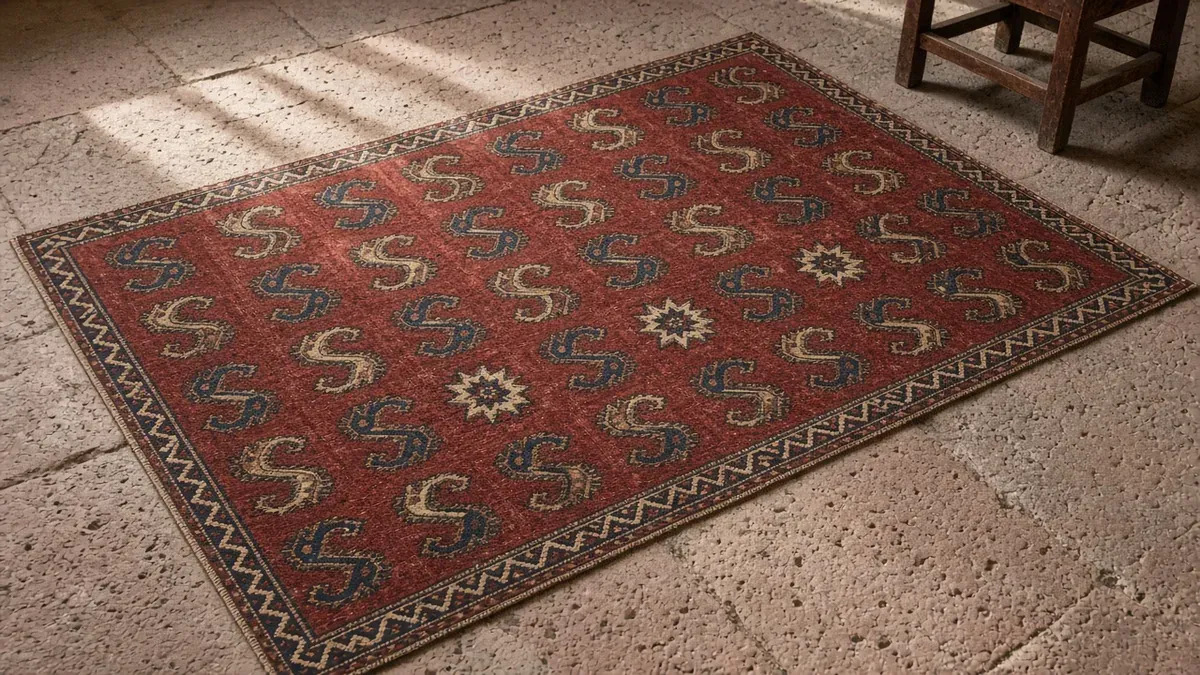
Armenian carpets are the knotted pile rugs and flat-woven rugs that Armenian women made for centuries for floors, walls, beds and church altars. Armenians call a pile carpet a gorg and a flat-woven one a karpet, and many old pieces carry the weaver’s name in Armenian letters.
This guide explains where the craft comes from, what the red dye and the dragons mean, and where you can see and buy Armenian carpets in Yerevan today. It also covers the export licence an old rug may need before you fly home.
Key Facts
- Armenian words: gorg (pile carpet), karpet (flat-woven rug without pile)
- Oldest dated Armenian carpet: the Gohar dragon carpet, 1699 or 1700
- Famous dye: vordan karmir (“worm’s red”), from an insect of the Ararat plain
- Where to see them: History Museum of Armenia, Megerian Carpet museum in Yerevan
- Where to buy: Megerian and Tufenkian showrooms, the weekend Vernissage market
- Old rugs: an export licence from the Ministry of Education, Science, Culture and Sports; fee 5,000 AMD (November 2026)
In this guide · 5 sections
History of Armenian Carpets
Two Armenian Words
Armenian has two words for the craft. Gorg is a carpet with a knotted pile, and karpet is a flat weave without pile. The Smithsonian Folklife Festival notes that both could be woven on the same village loom.
The older form kapert, from kap (“knot”), appears in the 5th-century Armenian translation of the Gospels [CHECK: primary source]. The word gorg is cut into a wall of Kaptavan church in Artsakh (Nagorno-Karabakh), in an inscription of 1242–1243 [CHECK: primary source].
You may also read that English “carpet” comes from Armenian. However, the Online Etymology Dictionary traces it to Old French carpite and Medieval Latin carpita, “thick woolen cloth”, probably from Latin carpere, “to pluck”.
Early Records
The oldest surviving pile carpet in the world is the Pazyryk carpet in the Hermitage. It was found in a frozen burial mound in the Altai and dated to the 5th–4th centuries BC. The museum says its exact origin is unknown.
Some scholars, such as Ulrich Schürmann and Volkmar Gantzhorn, argued for an Armenian workshop. Others see a Persian or Central Asian work. So the Pazyryk carpet is a debate, not proof, and no inscription settles it.
Written records are clearer. The Armenian Studies Program at Fresno State notes that carpets were part of Armenia’s yearly tribute to the caliph in Baghdad in the late 8th century [CHECK: second source]. Five centuries later, a famous traveller praised the weavers by name.
“The other two classes are the Armenians and the Greeks… They weave the finest and handsomest carpets in the world.”
Marco Polo, on the province of Turcomania, 13th century (Yule translation)
The Dragon Carpets and the Gohar Carpet
From the 15th to the 18th centuries, weavers in the Caucasus made the great “dragon carpets”, or vishapagorg. Stylised dragons sit inside a large diagonal lattice. A study published by the French archive HAL links most later Artsakh types to this group.
Several dragon rugs carry Armenian inscriptions, and that is how scholars tie them to Armenian weavers. The best known is the Gohar carpet. Its weaver, Gohar, wove her name and a date in the Armenian calendar into the top border.
The Armenian heritage site GenaGir translates the inscription: “I, Guhar, full of sin and weak in soul, with my newly learned hands wove this, whoever reads say a word of mercy.” The date equals 1699 or 1700.
The Gohar carpet of 1699–1700 is the oldest dated Armenian carpet, and its weaver signed it herself.
From Village Looms to Haygorg
In the 19th century, the Smithsonian Folklife Festival writes, almost every village home had a loom. Weaving was seen as pious work, and it was mostly women’s work. Then town workshops grew in the Russian and Ottoman empires.
These traditions declined fast by the First World War. In Soviet Armenia, production was revived through cooperatives and, from 1963, the state carpet unit Haygorg (“Armenian carpet”). After 1991 many old carpets left Armenia for private collections.
Colours and Patterns
Vordan Karmir, the Worm’s Red
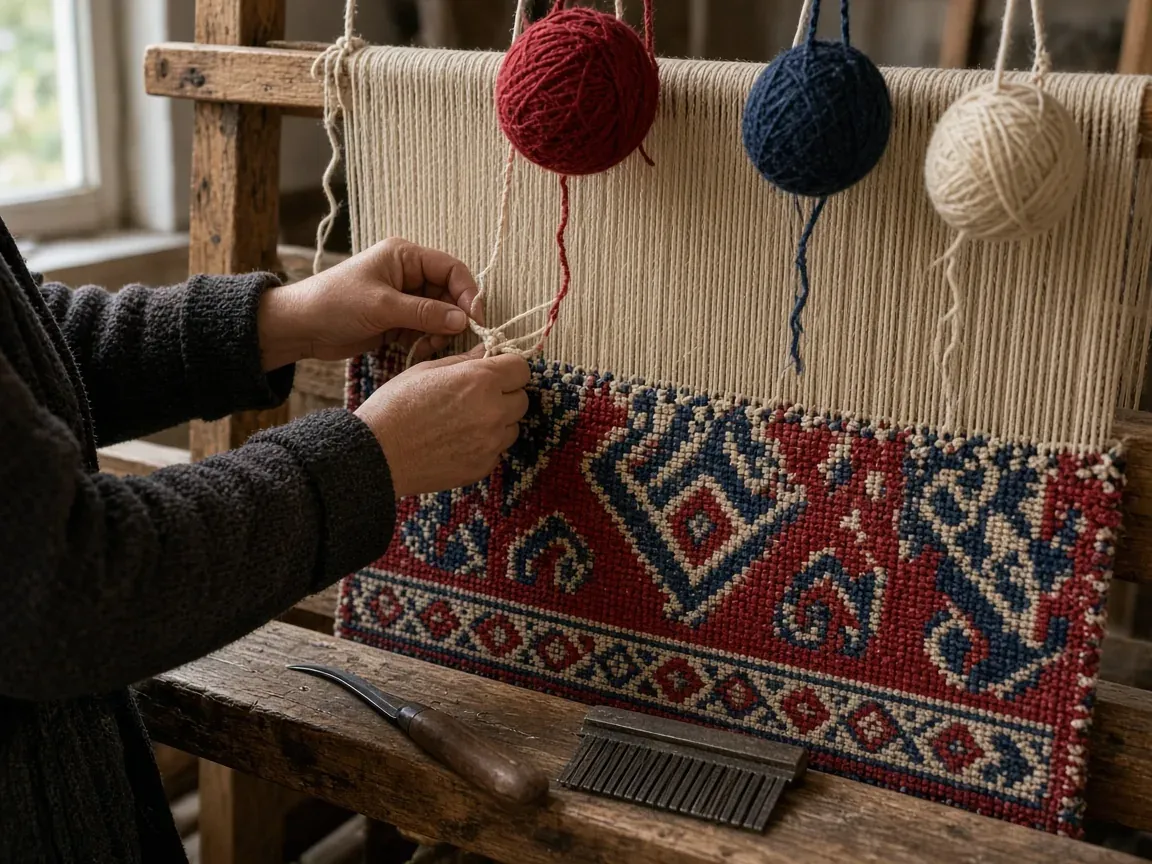
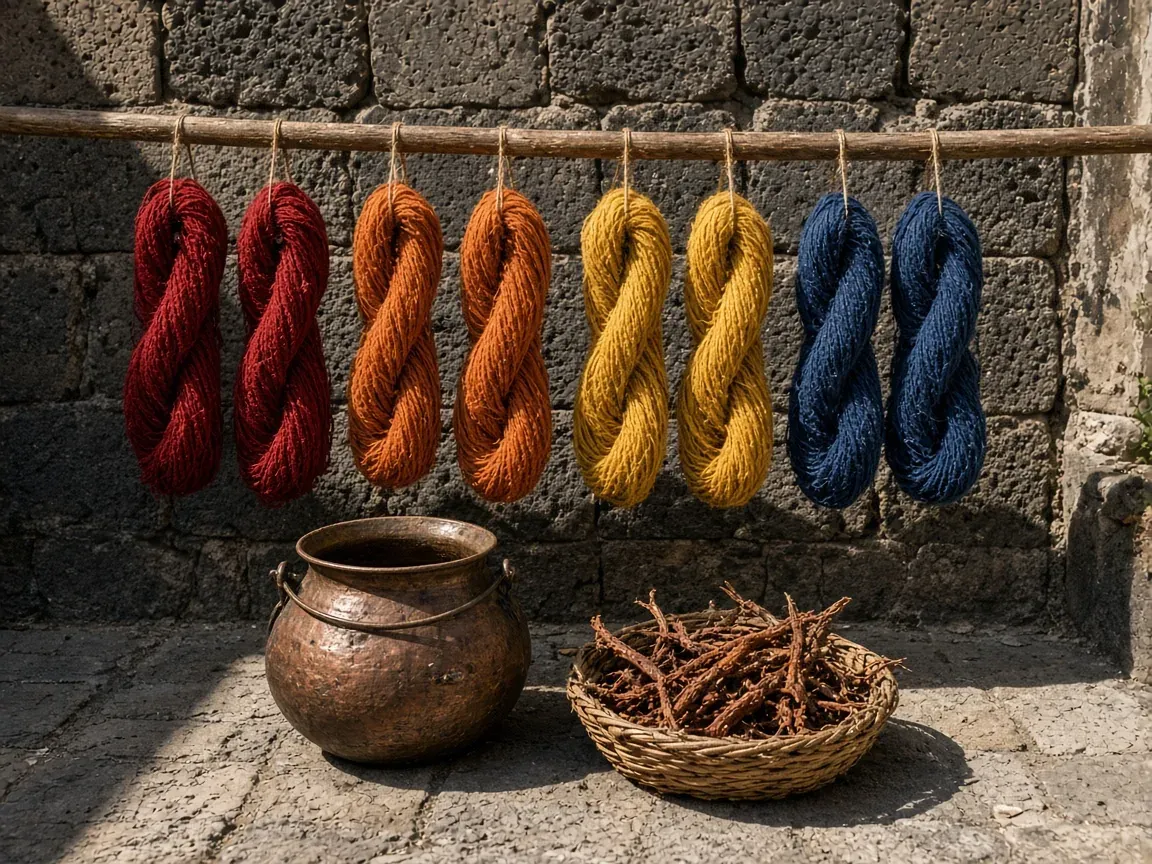
The red of old Armenian carpets often came from vordan karmir (“worm’s red”). It is the dye of the Armenian cochineal, a small scale insect that lives on the roots of grasses in the salty soil of the Ararat plain.
In the 5th century, the historian Ghazar Parpetsi already praised the Ararat plain for these insects. Arab and Persian writers of the 8th–10th centuries called Artashat “the town of kirmiz”. The same red coloured illuminated manuscripts, which you can see at the Matenadaran.
Today the insect is rare. The Vordan Karmir state reserve was created in 1987 to protect its salt meadows, and the species is in the Red Book of Armenia. As a result, most new carpets use plant dyes or other reds.
What the Patterns Mean
Carpet scholars read the ornaments almost like a script. The History Museum of Armenia calls its carpets ornamented “texts” that keep the old beliefs of the Armenians. A 2023 study in an Armenian academic journal lists the motifs you will meet most often.
- Vishap – the dragon, keeper of water and wisdom, usually woven in pairs as guards
- Tree of Life – the tree as ancestor, often with figures on both sides
- Cross and star – the most common signs, in many variations
- Turning cross – a cross with bent arms for rotation and eternity, close to the eternity sign of the Armenian symbols
- Birds and two-headed animals – winged guardians; a two-headed creature watches in both directions
The museum adds that Armenian weavers love variation, especially in colour. In fact, the same ornament can return in dozens of colourings, so no two old rugs are quite alike.
Traditions Around the Loom
A girl’s first carpet was a family event. The weaver Hratch Kozibeyokian told the Smithsonian Folklife Festival that her father built the loom, set the warp and tied the first foundation. When she finished, he cut the threads he had tied.
At the last cut, the finished rug falls over the young weaver’s head. Armenians call it glkhin ynkav (“it fell on her head”). According to the folk belief, if the carpet covers her head and face like a veil, she will marry within a year or so.
That is why the first rug was seen as a girl’s first accomplishment. At the 2018 Smithsonian festival in Washington, Armenian weavers showed this rite with a silk rug woven in Yerevan.
Where to See Armenian Carpets
History Museum of Armenia
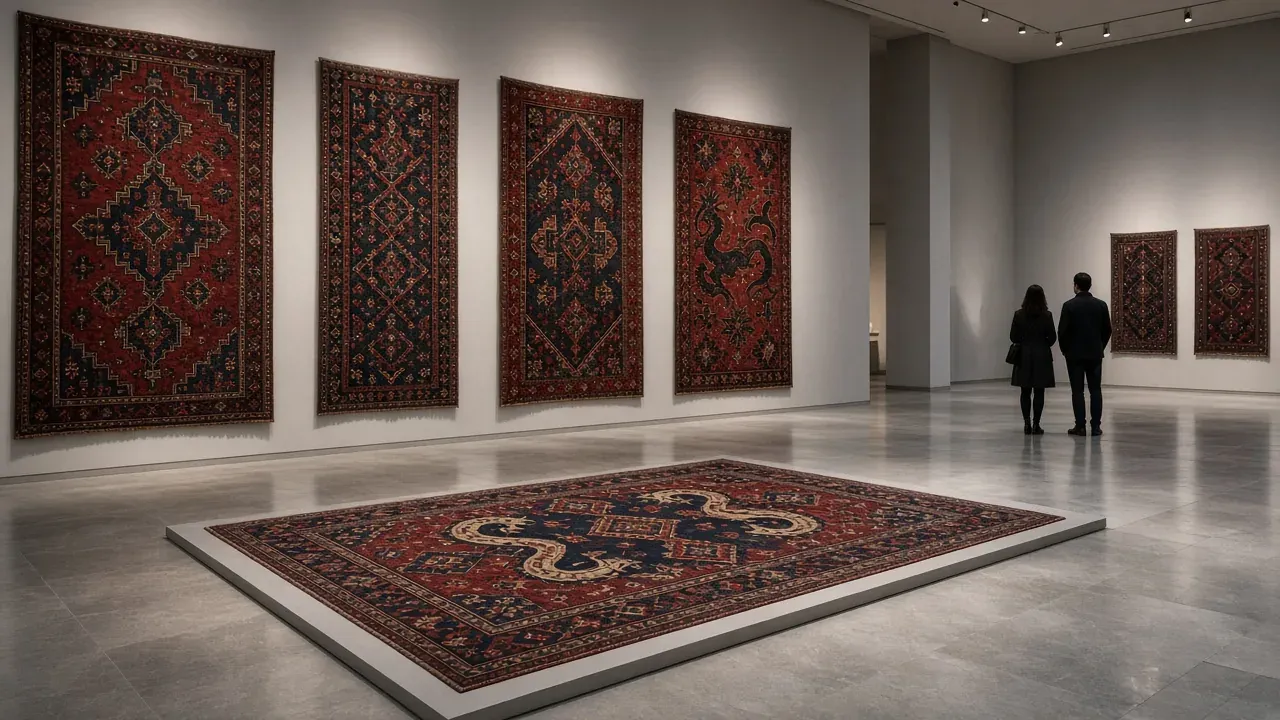
The History Museum of Armenia on Republic Square has a permanent hall, “Armenian Carpet Art, 14th–20th Centuries”, on the first floor. It shows carpets from Vaspurakan, Shirak, Syunik, Artsakh, Cilicia and other historical regions.
Beside the carpets, the hall shows clay, bronze and stone objects whose ornaments return in the rugs. The museum opens Tuesday to Saturday 11:00–18:00 and Sunday 11:00–17:00, and a ticket costs 2,500 AMD (November 2026).
The museum also hosts carpet shows. James Tufenkian’s collection of 19th-century Armenian carpets drew more than 100,000 visitors before it closed in January 2025. Another show, “Fragments of Identity: Carpet”, closed on 17 March 2026.
Megerian Carpet Museum and Factory
The Megerian Carpet cultural complex is at 9 Madoyan Street in Yerevan. Its museum of antique rugs opened in 2014. A tour of 30–40 minutes covers the museum, the weaving hall and the showroom, in Armenian, English or Russian.
The tour costs 3,000 AMD and is free if you buy a rug or eat in the restaurant (November 2026). You see weavers tie the Armenian double knot, and you see how finished rugs are washed, brushed and sheared. Book ahead; opening hours vary [CHECK: current hours].
The Shushi Collection
The Shushi Carpet Museum in Artsakh opened in 2013. During the 2020 war its founder, Vardan Astsatryan, moved about 160 carpets to Yerevan on 1 November 2020, and 71 of them were shown there in 2021. In August 2024 he said they were in private storage, with no permanent home yet.
Where to Buy Armenian Carpets
Workshops and Showrooms
Megerian sells new rugs from its showroom after the tour. Tufenkian Artisan Carpets has made handmade rugs in Armenia since the 1990s, with weaving in Yerevan and in the Armavir, Shirak and Gegharkunik provinces.
Tufenkian’s Yerevan showroom opened in August 2013 at 48 Hanrapetutyan Street, across from the Vernissage. Its weavers show the technique there, and it sells both traditional and modern designs.
Yerevan Vernissage
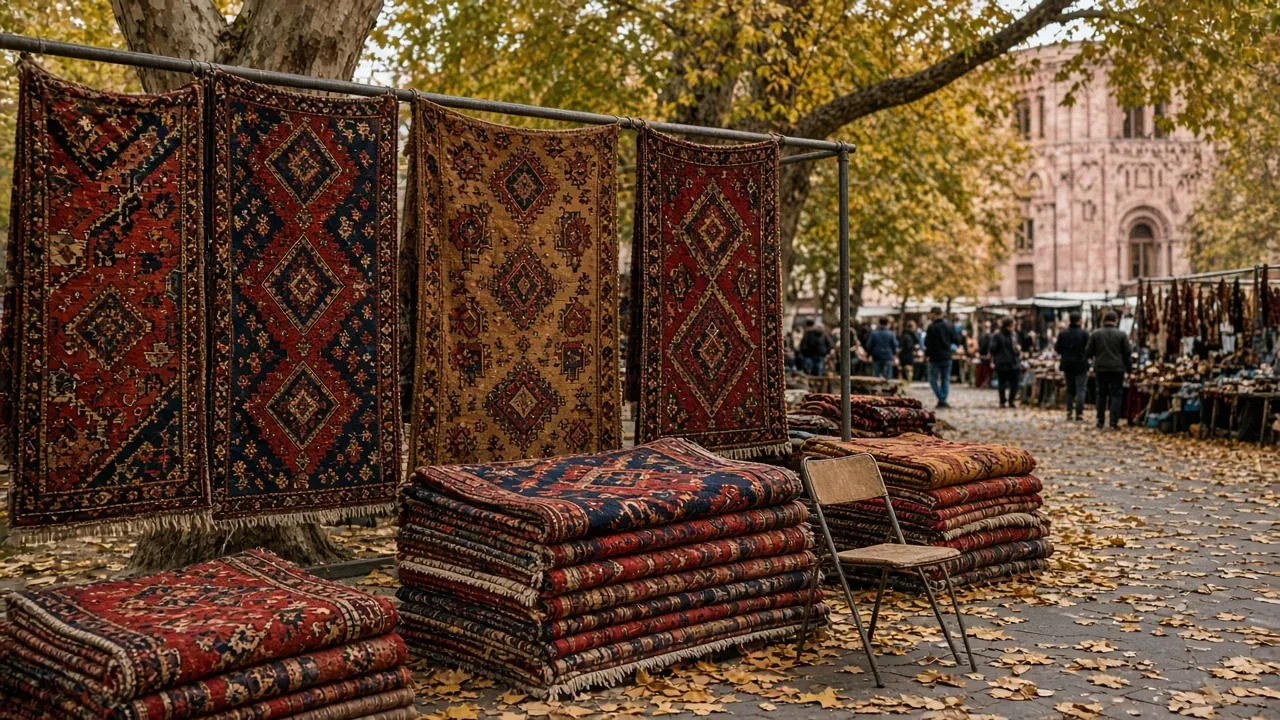
The Yerevan Vernissage, the open-air craft market near Republic Square, has rows of rugs on weekends. You find antique, used, new handmade and machine-made pieces side by side. So the market is the best place to hunt, and the place to look most carefully.
Rugs also used to star at the Dilijan fair once called the Carpet Festival. Today it is a wider crafts festival, and carpets appear only in some years.
How to Check a Rug
- Turn it over – on a hand-knotted rug the pattern shows clearly on the back, and the knots are slightly uneven
- Look at the colour – natural dyes shift gently inside one colour; flat, even colour often means synthetic dye
- Ask – the age, the region, wool or silk, and whether the dyes are natural
- Get a receipt – with the age, origin and price written on it, for customs
Taking an Old Carpet Home
An old carpet can count as a cultural value in Armenia. The Australian government’s travel advice says you need approval from the Ministry of Education, Science, Culture and Sports to export antiques, including carpets. Keep every receipt for customs.
The licence is requested through Armenia’s online services platform. You need the application, a passport copy, three photos of the carpet and an expert opinion. The fee is 5,000 AMD, and the answer comes within two working days (November 2026).
There is no single age printed on that page that makes a rug “old” [CHECK: age threshold]. So, for anything that is not clearly new, ask the seller to arrange the paperwork before you pay. Then pack the certificate with your passport.
Buying an old rug? Get the export licence before your flight, not at the airport.
So, when you are in Yerevan, start at the carpet hall of the History Museum, watch the knots being tied at a workshop, and then walk the Vernissage rows. Take your time, turn the rugs over, and choose the one whose colours you would like to live with.
Questions Visitors Ask
What is the difference between a gorg and a karpet?
A gorg has a knotted pile. A karpet is flat-woven, without pile, like a kilim. Both were woven by Armenian women, often on the same loom.
Can I take a carpet out of Armenia?
Yes. For a new rug, keep the receipt. For an old one, get an export licence from the Ministry of Education, Science, Culture and Sports first; the fee is 5,000 AMD.
Where can I watch carpets being woven in Yerevan?
At the Megerian Carpet complex on Madoyan Street, on a booked tour, and at the Tufenkian showroom on Hanrapetutyan Street.
Sources
- History Museum of Armenia, “Armenian Carpet Art, 14th–20th cc.”, permanent exhibition, read 22 November 2026. historymuseum.am
- History Museum of Armenia, “Hours and Admission”, read 19 November 2026. historymuseum.am
- History Museum of Armenia, closing of “Fragments of Identity: Carpet”, 17 March 2026. historymuseum.am
- Mediamax, “James Tufenkian dreams of establishing an Armenian carpet museum in Yerevan”, 21 January 2025. mediamax.am
- Smithsonian Folklife Festival, “Armenia: Carpets”, 2018. festival.si.edu
- Smithsonian Folklife Festival, “The Rug Fell on Her Head”, 17 September 2018. festival.si.edu
- Armenian Studies Program, Fresno State, “Arts of Armenia: Textiles”. fresnostate.edu
- “Artsakh – Karabagh. Rugs and Carpets”, book chapter, 2011, HAL. hal.science
- GenaGir, “Guhar Armenian Carpet”: the inscription. genagir.am
- “The Fundamental Conception of the Art of Armenian Carpet Weaving”, 2023, DOI 10.54503/1829-4073-2023.1.115-141. arar.sci.am
- State Hermitage Museum, “Pile Carpet” (Pazyryk). hermitagemuseum.org
- Iconotheca, “The Pazyryk Carpet: provenance”: the attribution debate. iconotheca.com
- Marco Polo, The Book of Ser Marco Polo, Book I, chapter II, translated by Henry Yule. Toyo Bunko digital archive
- Handbook of Natural Colorants, 2nd edition, Wiley, 2023, chapter 1, box 1.2 “Armenian cochineal”. wiley.com
- Wikipedia, “Armenian cochineal”, read 22 November 2026 (further reading). en.wikipedia.org
- Online Etymology Dictionary, “carpet”. etymonline.com
- Megerian Carpet, “FAQ”: address, tour, fee, languages, read 22 November 2026. megeriancarpet.am
- Advantour, “Megerian Carpet Factory, Yerevan”: museum opened 2014. advantour.com
- Tufenkian Carpets, “Tufenkian Carpets Yerevan”: showroom since August 2013. tufenkiancarpets.eu
- Barev Armenia, “Master class on carpet weaving” (Tufenkian Trans Caucasus): production provinces. barevarmenia.com
- Armenpress, “Carpets from Shushi Museum displayed in Yerevan”, 20 February 2021. armenpress.am
- Western Armenia TV, interview with Vardan Astsatryan, 12 August 2024. westernarmeniatv.com
- Smartraveller (Australian Government), “Armenia”, updated 17 June 2026: export of antiques. smartraveller.gov.au
- Hartak, Armenia’s unified services platform, “Export licence for cultural values” (in Armenian), read 22 November 2026. hartak.am
Discover more of Armenia’s culture and traditions on iArmenia.