Last updated: November 2026
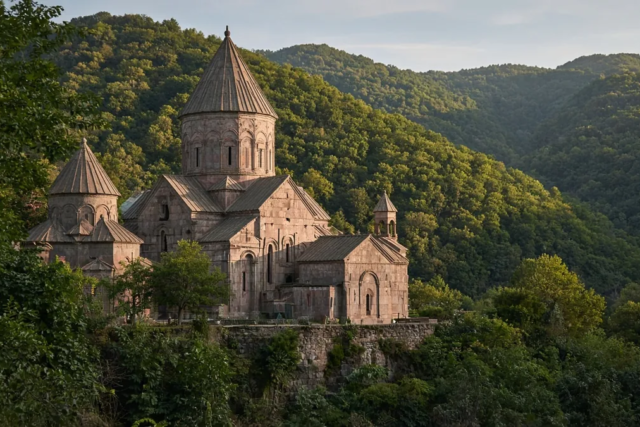
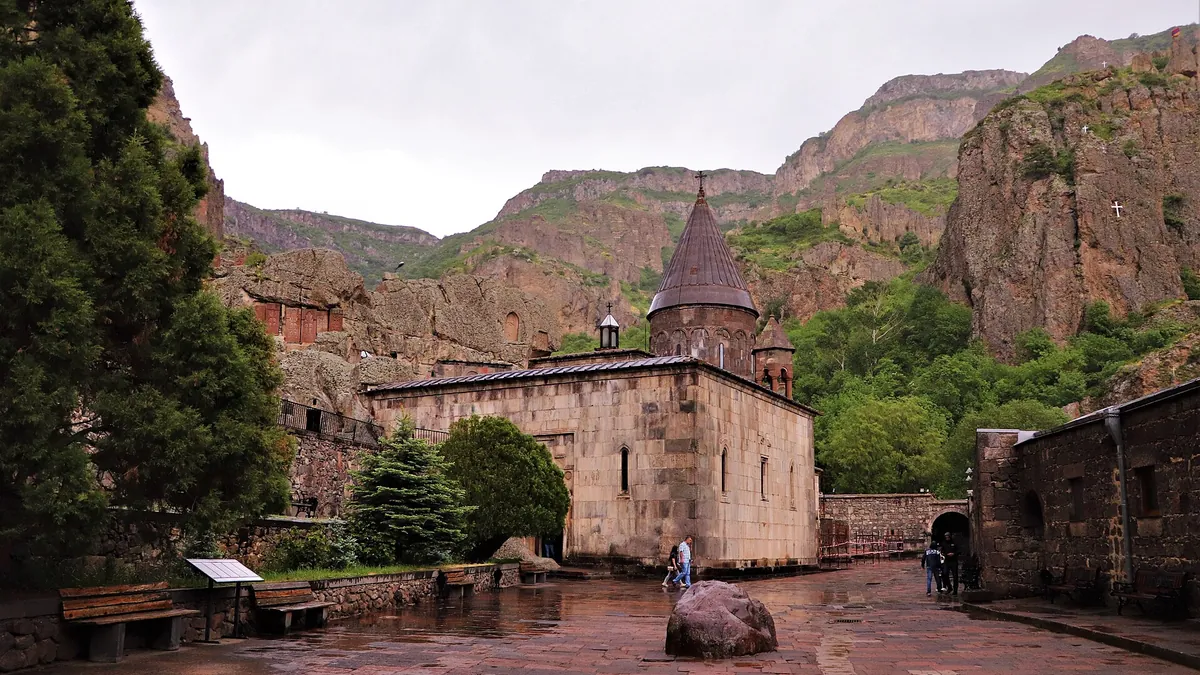
Geghard Monastery is a medieval monastery partly carved into the rock at the head of the Azat valley, about 40 km east of Yerevan by road. Its name means “monastery of the spear”. It is named after the lance said to have pierced Christ’s side, which was kept here for centuries.
Since 2000 Geghard has been a UNESCO World Heritage Site together with the upper Azat valley. You can combine it with Garni Temple on the same trip, a few kilometres down the road.
Key Facts
- Where: above Goght village, Kotayk province, at the end of the road past Garni; about 40 km by road from central Yerevan (roughly 45–60 minutes by car)
- Known for: churches and halls cut directly into the cliff; the acoustics of the rock-cut upper hall; the legend of the Holy Lance
- Main church: Katoghike, 1215; rock-cut churches and halls from the mid- to late 13th century
- Status: working monastery of the Armenian Apostolic Church; UNESCO World Heritage Site “Monastery of Geghard and the Upper Azat Valley” (2000)
- Tickets: no entrance fee; a small parking charge may apply
- Open: daily in daytime; there is no official timetable online and guides disagree on closing time, so plan to arrive before late afternoon (as of November 2026)
- Time needed: about an hour
- Dress: shoulders and knees covered, as in any Armenian church; women may want a headscarf
In this guide · 4 sections
History of Geghard Monastery
Ayrivank, the Monastery of the Cave
The site was holy before Christianity. A spring rises in a cave here, and springs were sacred in pre-Christian Armenia. According to tradition, Gregory the Illuminator founded a monastery at the spring in the early 4th century, after Armenia adopted Christianity in 301.
It was first called Ayrivank, “the monastery of the cave”. Monks lived in the caves around it. One of them is said to have been Gregory’s own cell.
Nothing from those early centuries survives. Arab troops plundered the monastery in the 10th century, and many of the manuscripts written here were lost. Some that survived are now in the Matenadaran in Yerevan.
The Zakarians and the Proshyans
The complex you see today belongs to the 13th century. At that time Armenian princes in the service of Georgia drove the Seljuks out of much of the country.
An inscription records that the main church, Katoghike, was built in 1215 under the brothers Zakare and Ivane Zakarian.
Its gavit (entrance hall) followed before 1225. Later in the 13th century Prince Prosh Khaghbakian, a vassal of the Zakarians, bought the monastery. It became the family monastery of the Proshyan princes.
The Proshyans paid for the most remarkable parts of Geghard. These are the rock-cut churches and halls dug into the mountain behind Katoghike between the 1240s and 1288.
The monastery later suffered from invasions and earthquakes and was repaired several times. It is still a working monastery. On Sundays and holidays you will see services, baptisms and weddings.
The Legend of the Holy Lance
Tradition says the Apostle Thaddeus brought the spear to Armenia. It is the spear with which a Roman soldier pierced Jesus on the cross. It was kept at the monastery, which became known as Geghardavank, “the monastery of the spear”, shortened to Geghard.
The relic, a flat iron spearhead, was later moved to Etchmiadzin. Today it is displayed in the treasury there. It is still used: when the Catholicos of All Armenians blesses the holy oil (muron) of the Armenian Church, the lance is one of the relics in the ceremony.
What to See at Geghard Monastery
Katoghike Church and the Gavit
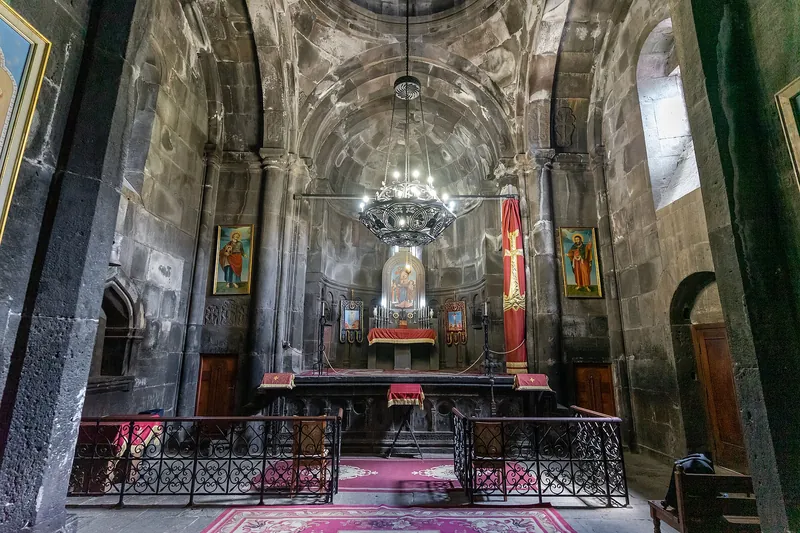
Katoghike (1215) is the free-standing church in front of the cliff. It follows the classic Armenian cross-in-square plan with a dome. Before going in, look at the façade. You will find a relief of a lion attacking a bull, and nearby the Zakarian coat of arms.
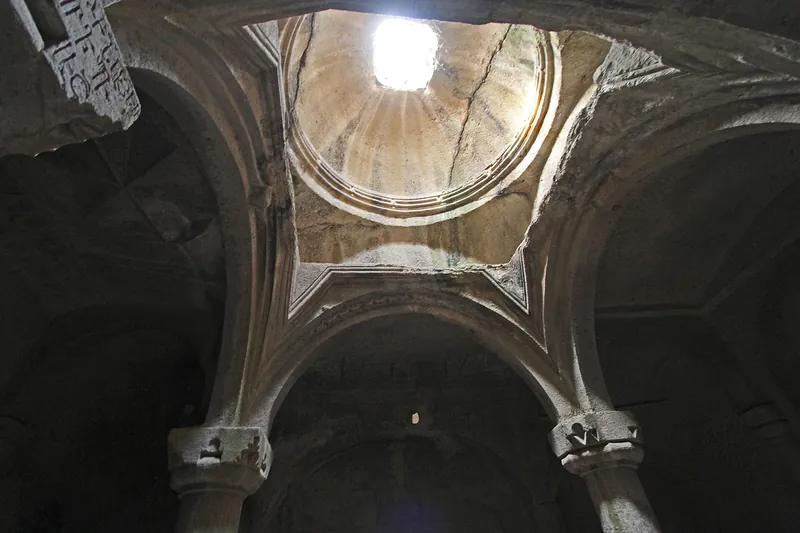
Inside, the walls carry building inscriptions. To the west is the gavit, a large hall built against the rock. Pilgrims were received here, and lessons and meetings were held. Its ceiling rests on four columns, with a light opening in the centre. From the gavit, doors lead straight into the rock.
Avazan: the Cave Church with the Spring
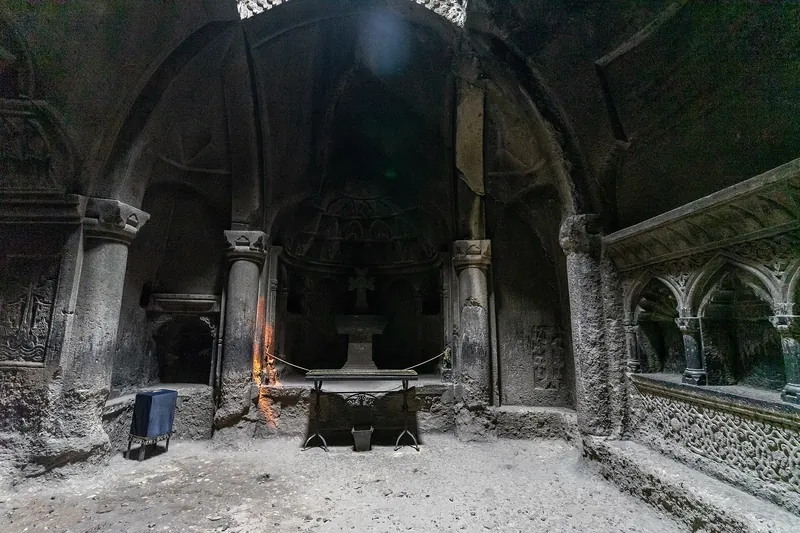
The first rock-cut church, from around the 1240s, is called Avazan, meaning “basin”. It is carved entirely out of the cliff in an equal-armed cross plan. The spring that made the site sacred still flows into a small basin by the north wall.
Many visitors wash their hands or face in it, or fill a bottle. Local people believe the water heals. An inscription near the dome asks you to “remember the varpet (master builder) Galdzak”, the architect of the rock-cut halls.
The Proshyan Tomb and Coat of Arms
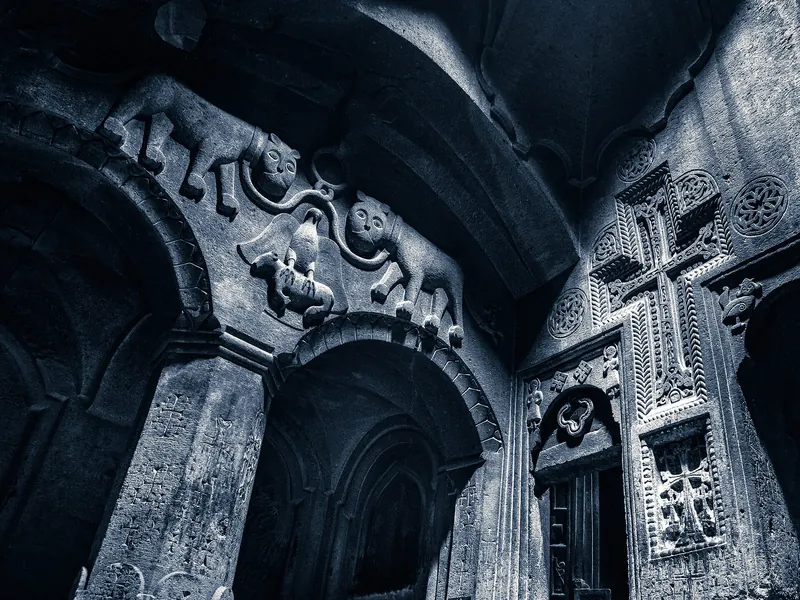
Next to Avazan is the second cave church and the tomb of the Proshyan family, completed in 1283. Over the north wall is the Proshyan coat of arms, carved in high relief. A bull’s or ram’s head holds a chain that runs around the necks of two lions. Below, an eagle clutches a lamb.
Prince Prosh’s inscription on the north wall gives the year 1283. Look also for the carved birds, crosses and armed men on the walls, and the round opening at the top of the dome.
The Upper Hall and Its Acoustics
A narrow passage and stairs outside the gavit lead up to the upper zhamatun (“hall”). It was cut into the rock in 1288 as a burial place for Prince Papak Proshyan and his wife Ruzukan. Four massive pillars, carved from the same rock, divide it into nine bays under a dome with a single opening to the sky.
The sound in here is remarkable. A single voice fills the space and seems to hang in the air. You may hear a visiting choir or a local singer try a sharakan (“Armenian hymn”); some musicians near the monastery ask a small fee.
A small opening in the floor looks down into the Proshyan tomb below. If nobody is singing, stand under the dome and hum.
Khachkars, Cells and the Wish Trees
All around the courtyard and along the path to the gate, the cliff is cut with khachkars (“cross-stones”) and the doorways of monks’ cells. Outside the walls, by the stream, trees are hung with strips of cloth. People tie them while making a wish.
You may also see people trying to throw a pebble into a niche in the rock. It is said to make a wish come true. These customs are older than Christianity in Armenia, and the church tolerates rather than encourages them.
How to Get to Geghard Monastery
By Car or Taxi
Drive east out of Yerevan through Nor Nork and past the Charents Arch to Garni. Then continue up the valley through Goght; the road ends at the monastery. It takes about 50 minutes.
Taxi apps such as GG and Yandex Go show the current fare from Yerevan before you book. Drivers waiting at the car park are not guaranteed. So book a return or agree waiting time with your driver.
By Minibus
Minibuses leave from Gai bus station in Yerevan for Garni, and route 284 continues to Goght, the end of the line (2025 guides). From Goght it is about 4 km uphill to Geghard, an hour’s walk along the road.
Guides disagree on whether any minibus goes all the way up to the monastery, so plan for the walk or a short taxi ride. Routes and times change; ask at Gai station. Don’t count on a ride back late in the day.
Geghard and Garni in One Trip
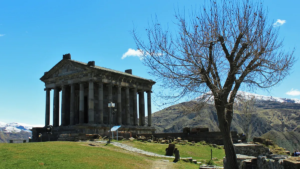
Geghard and Garni are on the same road, about 10 km apart by road, a 15-minute drive. Together they make the classic half-day trip from Yerevan. A pagan temple from the Roman era and a Christian monastery cut into the rock, so close together, show how long Armenian history runs.
With a taxi or tour you can see both in four to five hours. Without a car, take the minibus to Garni and see the temple. Then take a local taxi from Garni to Geghard and back. Agree the price, including waiting time, before you set off.
When to Visit and Tips
- Best time: weekday mornings. Weekends bring weddings and big groups, which are fun to watch but crowd the small cave churches. Arrive before the tour buses and finish at Garni, which is open later.
- Light: the rock-cut halls are dark. Let your eyes adjust; use a phone torch only if there is no service going on.
- Behaviour: keep your voice down, don’t use flash during services, and ask before photographing people praying.
- Snacks: stalls at the car park sell gata (sweet bread), sujukh (walnuts threaded on a string and dipped in thickened grape juice), dried fruit and fruit lavash. Bring small notes.
- Temperature: the caves are cool even in summer; a light layer helps.
- Walking: the path from the car park to the gate is short but sloping, and the steps up to the upper hall are steep and uneven.
So when you are in Yerevan, give Geghard Monastery a morning. Come early, drink from the spring in Avazan, and stand under the dome of the upper hall to hear how the rock carries a voice.
Questions Visitors Ask
Is Geghard Monastery free?
Yes. There is no entrance fee; you only pay a small charge for parking. Donations and candles are welcome.
What does Geghard mean?
“Spear”. The full name, Geghardavank, means “monastery of the spear”, after the Holy Lance that was kept here. The relic is now in the treasury at Etchmiadzin.
Is the whole monastery carved out of the rock?
No. The main church, Katoghike, and its gavit are built of stone in the usual way. Behind them, two churches, the Proshyan tomb and the upper hall are cut entirely into the cliff.
Will I hear singing at Geghard?
Sometimes, but not always. Visitors and local singers often try the acoustics of the rock halls, and tour groups occasionally bring a choir. If you arrive during a service, you will hear the liturgy in the rock churches.
Sources
- Monastery of Geghard and the Upper Azat Valley, UNESCO World Heritage Centre
- Geghard, Documents of Armenian Architecture 6 (1973), via Internet Archive
- Geghard Monastery, Crossing Frontiers, The Courtauld Institute of Art
- The Armenian Holy Site Where Music ‘Rings Like A Bell’, RFE/RL (2021)
- Geghard, Wikipedia
- Geghard Monastery guide, Absolute Armenia (transport, hours)
- A Short Guide to Geghard Monastery, Backpack Moments (buses, walk from Goght)
- Garni, Wikivoyage (minibuses, taxi from Garni to Geghard)
Discover more of Armenia’s monasteries, history, food and traditions on iArmenia.